
How to Answer Behavioral Interview Questions: A Former Amazon Interviewer's Guide
This article covers how to answer behavioral interview questions (often called BQs): what they are, why companies use them, and how to structure your answers. It’s for anyone preparing for interviews who wants to show their soft skills better.
Behavioral questions are a key part of how interviewers judge your soft skills and how you work. My former employer, Amazon, is famous for them: we used BQs to assess whether a candidate fits the company culture (the Leadership Principles). Here I’ll share what I learned interviewing at Amazon so you can handle BQs with confidence.
What is a behavioral question?
A BQ asks about a real situation you faced in the past. The interviewer uses that past experience to predict how you’ll perform at their company.
You’ll be asked to describe a situation and explain how you handled it.
These questions usually focus on workplace soft skills such as:
- Communication
- Problem solving
- Teamwork
- Handling pressure
They often start with “Tell me about a time…”, for example:
- “Tell me about a time you faced a difficult challenge.”
- “Tell me about a time you had a conflict within your team.”
- “Tell me about a time you failed.”
The point is to use your past to predict your future behavior, so telling your experience in a clear, structured way matters a lot.
Why do companies ask behavioral questions?
Companies use BQs mostly to assess culture fit and how well you work with a team. There are a few reasons:
- Predicting future behavior. Past behavior is the best predictor of future behavior. By seeing how you reacted in specific situations, a company can judge whether you’ll respond well to similar challenges.
- Assessing soft skills. Soft skills like communication, leadership, teamwork and handling pressure matter as much as hard skills. For some roles, such as PM, they can matter more than the technical side.
- Culture fit. Company culture is critical to whether the relationship works long term. BQs let interviewers check whether your values and working style fit the culture, which keeps poor fits out of the team and reduces friction and turnover.
- Showing how you think. BQs let you show your reasoning and how you solve problems. Interviewers want to see how you assess a problem, make a plan and act on it, which helps them judge whether you can handle real challenges on the job.
- Highlighting your achievements. BQs give you a chance to show what you achieved in past jobs and what you actually contributed. Concrete examples build trust in your abilities and give interviewers measurable data to evaluate you with.
How to answer behavioral interview questions
The core idea: respond to what they need
I think the key to BQs, and really the key to this whole series, is “respond to what they need”: the job description (JD) and the company culture.
What does that mean in practice? Put simply, you mirror their language. Your answer should tie back to keywords from the JD or the company culture.
I recommend saying a few of the important keywords outright in your answer. If you can say it directly, don’t hide it.
For example, Amazon cares a lot about Customer Obsession and Earn Trust. If you get “Tell me about a time you faced a conflict,” consider putting both of those phrases right into your answer. Something like:
The conflict was that you wanted to give customers a better product, and some tests still weren’t passing, but some people on the team wanted to release anyway. You believed quality was key to “Customer Obsession,” so you insisted on finishing the tests. Then, to “Earn Trust,” you did [some kind of] communication to make sure each stakeholder’s key needs were met.
How do you find out what they need?
- The main clues are usually in the job description (JD).
- The other source is the “culture” section of the company website. Larger companies usually publish this.
For example, these are Adidas’s values. When I prepared BQs for Adidas, I kept emphasizing Innovation and Ownership.
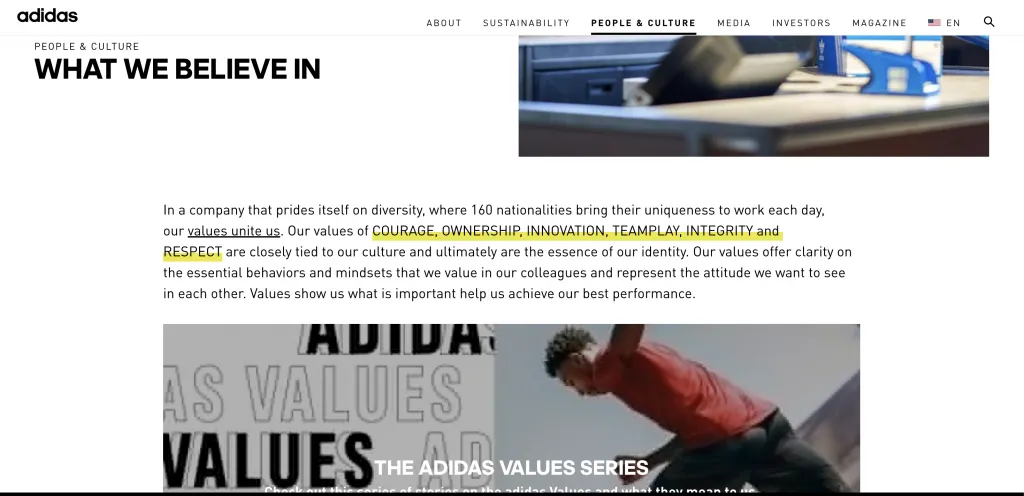
If the company doesn’t publish its values, it may be a smaller company. In that case I pull keywords from the interviewers’ public LinkedIn posts and then mirror them as much as I can.
Prepare your stories
Once you know the direction, prepare your stories.
I suggest preparing stories for some common themes, such as:
- Conflict
- Collaboration
- Stakeholder management
- Customers
- Managing timelines
- Adaptability
- Failure
- Quality
Prepare a few stories for each.
I recommend at least ten stories, with every theme above covered by at least one.
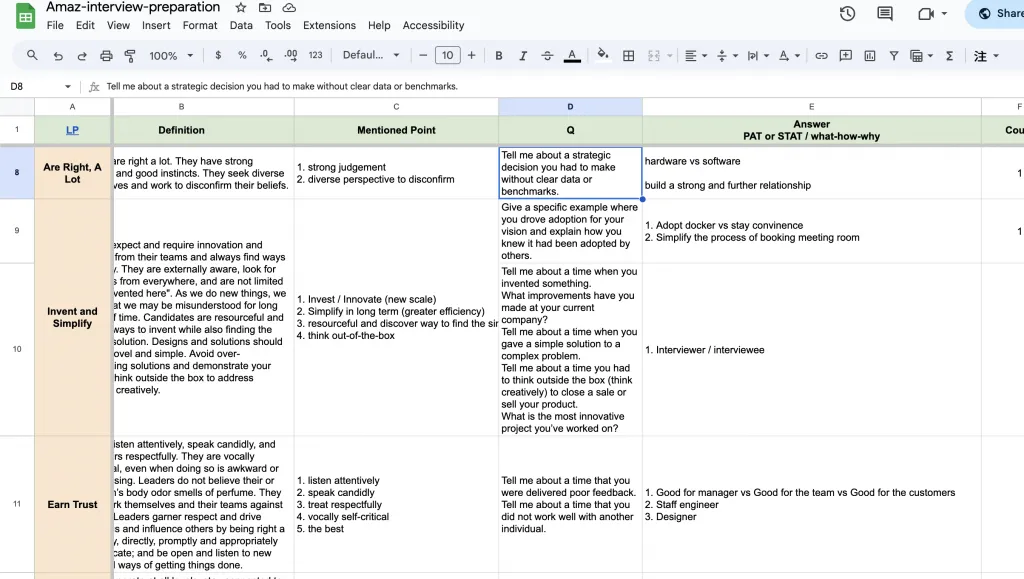
For a Dream Job, I suggest preparing a story for each culture value (stories can overlap). Below is the sheet I used to prepare my Amazon BQs.
Answer structure
There are many frameworks for answering BQs. The classic and most effective one is STAR.
It’s a structured framework that helps you organize and deliver information well.
I pick it because it’s simple but effective, and there’s plenty of reference material online. Once you’ve used it for a while, you can add your own extensions.
The STAR method, with examples
- S - Situation. Describe the background so the interviewer understands the challenge. For example, explain your position and role at the time, and what the problem was.
I was a software engineer at [company], responsible for developing a new product. But the engineering team was short-staffed and the product requirements kept changing, so the project fell behind schedule.
- T - Task. Explain your specific task or responsibility in that situation.
My task was to make sure the project shipped on time, and to replan the schedule to meet the client’s needs with limited resources.
- A - Action. Describe specifically how you handled the challenge, emphasizing the steps you took.
First, I had one-on-ones with each team member to understand their difficulties. I realized the problem was adopting a new testing framework, so I worked with their manager to test the critical features with our existing framework first, so the schedule wouldn’t slip. I also set up a daily progress meeting to solve problems quickly and keep the project moving.
- R - Result. Summarize the outcome and highlight the positive impact on the project or team. Concrete numbers work best.
With these changes, we finished the project two weeks early, the client was very happy with the final product, and the project brought the company 10% more revenue than expected.
I also suggest adding an extra S (Summary) at the start to frame the answer, and again at the end to tie it back. The full structure becomes S-STAR-S.
There are other frameworks too, like SBI. Personally I don’t think you need anything fancy. Pick the classic one and deliver it steadily. I’ll cover the others another time.
Wrapping up
I actually like BQs. In a way they push you to tell stories and sum up what you’ve learned from your past.
Whenever I hit a setback, I think:
“Damn, once I get through this awful challenge, I can use it as a BQ story.”
For example, I once worked with a PM who loved quick calls. They kept breaking my focus, and at first I was annoyed. I felt she didn’t respect other people’s time.
What I did was learn how she liked to communicate and set one or more fixed daily sync times for her. After that, we worked together smoothly.
That’s a simple BQ story right there.
In short, behavioral questions help companies predict your future performance from concrete past behavior. They give interviewers a fuller picture of your soft skills, values and culture fit.
For you as a job seeker, answering BQs well lets you show real past achievements and problem-solving ability, and highlight your soft skills and how well you’d adapt to the company culture.
So prepare your BQs ahead of time and answer from your real experience. It will greatly improve your chances of passing the interview.