
Coach Chiao's Data-Driven Guide to Job Hunting Abroad: Let Data Steer Your International Career
I’m Coach Chiao (George), an international career coach and former software engineer at Amazon in the US. Many of us have what it takes to work in the global market, but don’t know how to start or worry we aren’t good enough. This series is here to show you that getting a job abroad follows a pattern you can learn.
Whenever I talk with friends about working abroad, the same questions come up:
- “I don’t know if I should go abroad.”
- “If I work abroad, where should I go?”
- “I want to go abroad, but how do I start?”
- “I want to go abroad, but are my skills and English good enough?”
- “I want to go abroad, but is it too late? Am I too old?”
Before I landed my first offer, I wasn’t sure either. Did I really have a chance? Was I really good enough for a job abroad? This series draws on the lessons from my own job search, what I learned from coaches, and the experience of helping friends, family and mentees with their searches. The common thread is using data to answer our own challenges.
In fact, every one of these questions, including where to go, whether you’re qualified, whether you have a chance, and even whether you need to go back to school, can be answered with data.
I first wrote this series for a 30-day writing challenge, so most examples use software engineers. But the method works for any job abroad that takes a lot of applications, including data scientists, business analysts and project managers.
I won’t claim it’s a cure-all that solves every problem. What I can say with confidence is that this series will help you move forward a lot.
Common questions about job hunting abroad

When people consider working abroad, they often ask:
- Should I go abroad?
- Which country should I work in?
- How do I start preparing?
- Are my skills and English good enough?
- Am I too old to go abroad?
These questions reflect the uncertainty and anxiety job seekers feel when looking for work abroad.
About me: a software engineer and an international career coach

The Amazon Spheres in Seattle, or as I call them, the very well-made Seattle eggs.
- Experience: software development engineer (SDE) and Scrum Master at Amazon (US); design thinking facilitator and coach at MoodWide Consulting
- Certifications: PMI Project Management Professional (PMP)
- Publications: Leadership on the Line (2021); Testing Web APIs: From Design to Implementation, Delivering High-Quality APIs (2023); Succeeding with Agile (2025, planned)
I grew up, studied and worked in Taiwan, living an ordinary, stable life. Then in 2020 I saw a friend earn three times my salary while working a third of my hours, and I made up my mind to find a job abroad.
I didn’t study computer science, so when I started applying I had no direction. I applied for everything: business analyst, software engineer, project manager. After countless attempts, I finally got a few offers.
Of the jobs that sponsored a visa, the Amazon role paid the most, so I took it. From starting my search to my first day, the whole process took about nine months.
The journey wasn’t smooth. My mood went up and down every day, like riding a roller coaster.
- Every positive response made me ecstatic.
- But one shaky interview answer could send me into days of discouragement and self-doubt.
- Every day I wondered whether I should give up.
In the end I realized how important it is to find a job search rhythm that suits you. That planted the seed for me to become a coach and help others find the right pace in their own job search.
After reading a lot, getting guidance from several mentors and coaches, and reflecting deeply on my own painful experiences, I put together a method backed by clear data: the Data-Driven Job Search method.
Using this method, I’ve helped about 200 people find jobs abroad within nine months. It isn’t some earth-shattering secret, but I want to share it so it helps more people on this path.
Note: I like looking at data, and in tech it’s a useful skill to build. Data in this article is marked with a number in square brackets, like [1], and the sources are listed at the bottom.
Why look for a job abroad?
Being clear about your why helps you make better choices.
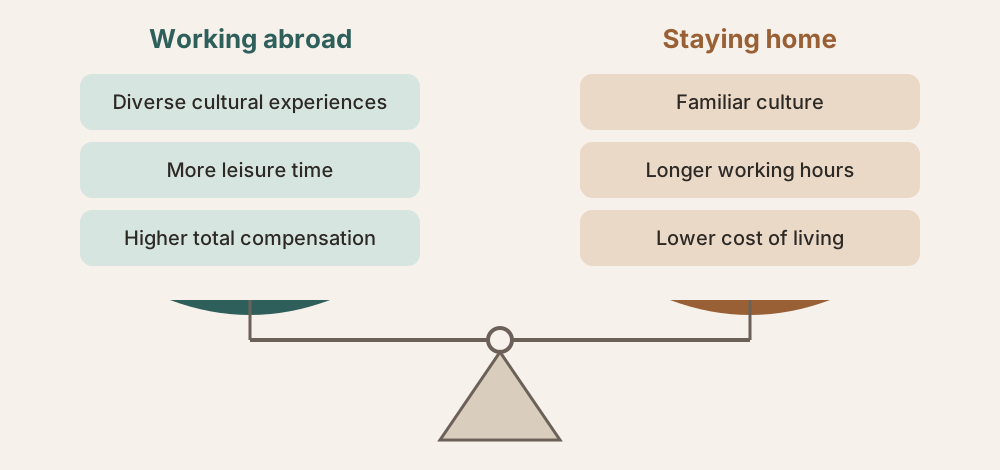
Working abroad, especially in Europe and North America, usually brings a few benefits, along with some matching challenges.
-
Better pay
I mainly mean total compensation. Average software engineer pay in Taiwan ranks 42nd [1]. Rent, living costs and taxes are relatively low, so Taiwan ranks somewhat higher on disposable income, at 22nd [2].
Some people say living costs abroad are high too. My take: if your income triples and your costs triple, your savings triple as well. If saving money is your goal, that’s all the more reason to try.
-
More time for life
Hard work is highly valued in Asian cultures, but working hours in Europe and North America are usually not as long (it depends on the team, of course).
On average, Taiwanese work 1.16 times as many hours [5]. My own sense is that hours in Taiwan are even longer, especially in high-paying industries.
More free time doesn’t automatically mean a better quality of life. In Europe and North America, a lot of it goes to commuting, grocery shopping and cooking, since eating out is expensive and less common.
-
Experiencing a different culture
This is harder to measure, but even more priceless.
Actually living in a few countries as a digital nomad breaks a lot of illusions and myths.
For example, I lived in Sweden for two months. I liked the social life and the social welfare there, but winter was too cold to run outside, and the only food I liked was potatoes, which counted against it.
-
Breaking through a career ceiling
Asian cultures are relatively unfriendly to older workers. Nearly 80% of older workers (over 45) report experiencing age discrimination [3], compared with about 25% in the US [4].
My point here is that older individual contributors (ICs) are more accepted in Europe and North America.
On LinkedIn you can also see that people who stay ICs instead of becoming managers are far more common abroad than in Taiwan. Moving into management is like changing careers, and in Asia it’s less friendly to older engineers.
These are the main reasons for me. I’m sure you have your own.
Of course, staying in Taiwan is good too. It’s the place that raised us, and a place we want to keep contributing to.
Personally, I encourage going abroad first. At least among the people around me, coming back to Taiwan with experience abroad is accepted and even admired.
You may have constraints, such as your family’s health or your age. We’ll go into those in detail later.
My family matters a lot to me, so I chose to go abroad around 30, while my parents were still young enough to visit. Later on, long-haul flights get harder. Also, the younger you are, the higher your immigration points usually are.
I expect to move back to Taiwan around 40, to be closer to my family.
Once you know your reasons and have the motivation, you’ll still face some challenges.
That’s what this series sets out to address.
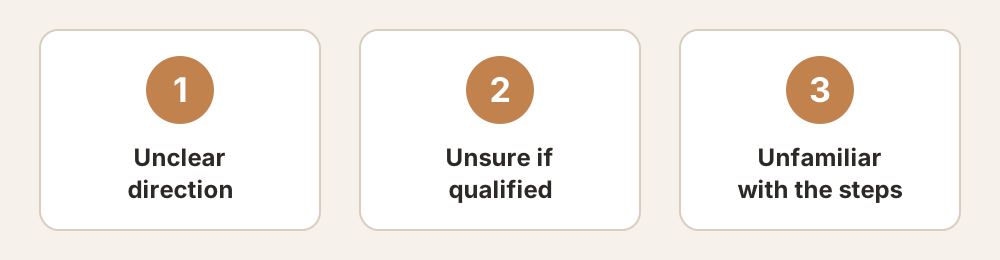
The three big challenges of job hunting abroad
-
Unclear direction
Many people considering a job abroad don’t know where to aim.
The US, with its booming tech industry? Europe, with a higher quality of life? Or a neighbor in Asia with a closer language and culture?
Without understanding each market’s demand, work environment and lifestyle, choosing a direction is confusing.
-
Unsure if you’re qualified
Self-doubt is a common obstacle in a job search.
We worry whether our skills are at an international level, or whether our English is good enough for the job.
Or whether not having a degree in the field will hurt our chances.
This uncertainty often holds people back, afraid they can’t stand out in fierce global competition.
-
Not knowing the steps
Even with a clear goal and confidence, many people still don’t know the practical steps of a job search.
They don’t know how to write a resume and cover letter to international standards, or which skills and experience companies abroad value.
Not knowing about interview processes, visa applications and cultural differences makes the whole job search complicated and intimidating.
Using data to overcome these challenges
In the rest of the series, I share which numbers are key to track and how to collect supporting data to back up your reasoning.
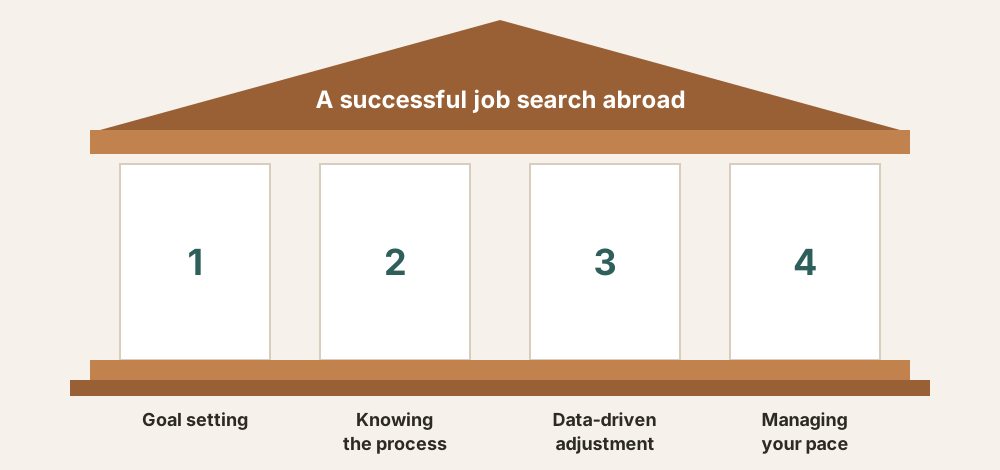
It mainly covers:
-
Setting clear goals
Use data from talking with more people, finding role models and listing your constraints (field, age, family, cost, visa and so on) to clarify your direction and your target country or city.
-
Getting familiar with the process of job hunting abroad
Learn how to write a resume and cover letter to international standards (and what information is necessary), understand how companies abroad interview and what they commonly ask, and research the visa requirements and work permit process of your target country.
-
Tracking where you are and adjusting how you spend your time
Use your key job search numbers to see where you stand: should you send more applications, connect with more people on LinkedIn, keep improving your resume, ask for recommendation letters, or strengthen your portfolio?
When to start interview practice (LeetCode) and which skills to strengthen can also be answered with data.
-
Finding your job search pace
Most people go through a job search at some point, and job hunting abroad is especially discouraging.
You may think your application is flawless and still hear nothing back, or leave an interview replaying how you could have answered better.
What I least recommend is pushing yourself to burnout. Finding the right rhythm is one of the most important lessons this journey teaches.
Summary
Working abroad isn’t out of reach. It’s a goal you can reach with a systematic method and data analysis.
I hope this series gives you a clear path and practical advice to help you move step by step toward a career abroad.
If you’d like to keep following along and talk about it, follow the series.
About Coach Chiao (George), career coach for job seekers abroad
I’m Coach Chiao (George), a career coach. I’ve spent more than ten years on facilitation and coaching, with over 3,000 coaching hours and 700 workshops.
I moved from Taiwan to a job overseas and received several offers, including roles at TikTok in Singapore, Mozilla in the UK and GitLab in the US.
In the end I chose to join Amazon in the US as a software engineer, then turned what I learned from that job search into a complete framework anyone can follow.
Since 2021, I’ve helped more than 180 mentees (software engineers, product managers, data engineers and business analysts) get offers abroad within nine months. My specialty is using data to support your job search.
References
- 1 - Levels.fyi: 2024 Software Engineer Compensation
- 2 - NARL: Women’s Disposable Income Worldwide. Limited as a reference: it covers women only and isn’t specific to tech.
- 3 - yes123 Job Bank: Survey on workplace risks and retirement planning (in Chinese)
- 4 - AARP: Workplace Age Discrimination Still Flourishes in America
- 5 - CommonWealth Magazine: working hours in Taiwan. The most recent data I found is from 2015.