
Can You Get a Job Abroad Without a Visa? A Practical Q&A on Visa Strategy to Raise Your Interview Rate
How to get a job abroad without a visa: why the visa matters so much
This continues my previous article on work visa options by country. In short, if you want to know how to get a job abroad without a visa, learning how to hack the visa is the important part. Using the red, yellow and green lights from that article, this one focuses on getting you from red to yellow within a year.
- Red light: You need support both now and in the future. Expect an interview rate hovering around 15%.
- Most companies that need someone productive right away don’t want to wait for your visa before you can start.
- Yellow light: You need support either now or in the future. Expect around 30%.
- Mid-size companies have the resources to help with your “future visa.”
- Large companies have the resources and time to help with both your “future” and “current” visa.
- Green light: You need no support now or in the future (usually meaning you’re a citizen or at least a permanent resident). Your interview rate can reach about 50%.
- If you’re below 50%, your answers to other questions can probably be improved.
The core process and strategy
- Set the overall direction: First explore a few countries you’re interested in. Later I’ll talk about “decision criteria” and “constraints”; your past and present give you data to help you move forward. At the very least you can use a process of elimination.
- Check eligibility and apply: This includes the age limit for applying, and whether the visa can be extended or converted to another status.
- Keep watching: If the application window hasn’t opened yet, keep an eye on it.
Common visa questions
1. Which visa should I use?
It depends on your direction and eligibility. Some people have a family member or partner who is a citizen and can use a family-sponsored visa.
If you have no such connections, my advice is: if you’re eligible for a working holiday visa, apply and keep it in your back pocket.
Some countries allow extensions. Australia, for example, lets you go up to three years. See the previous article.
2. Should I apply now, or wait until I’m sure about [something]?
For working holiday visas, most countries don’t limit how many times you can “apply,” but most limit you to “using” it once.
So if you’re starting to think about it, apply.
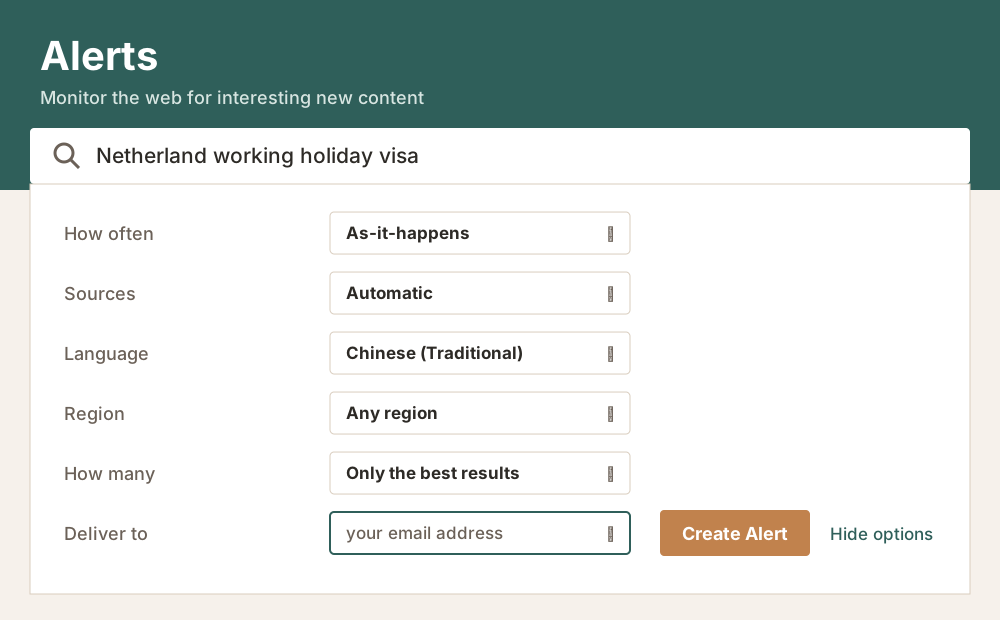
3. The application window for my country hasn’t opened yet. What now? Let Google track it for you.
- Open Google Alerts
- Enter your country plus visa keywords, such as “UK Working Holiday Visa”
- Have it send alerts to your inbox (filter out news if you need to)
4. I’m not eligible for my target country (most often, I’m over the age limit). What now?
First make sure you’re really over the limit. For an 18 to 30 working holiday visa, you can still apply up to the day you’re 30 years and 364 days old. One day more and you can’t.
If you’re definitely over the age limit, you’ll have to give up on the working holiday route and get the target institution (a school or company) to apply for you.
Application routes for common countries
Here are the routes for a few common countries.
United States
The US basically has no working holiday visa. The closest is the Summer Work Travel program under the J-1, but the jobs you can take are very limited, especially since the J-1 is mainly meant to make academic exchange and research easier.
So if you’re in academia (for example, a graduate student or researcher), consider emailing institutions you’re interested in, going the J-1 route, and then having the institution help you switch to an H-1B.
These are the institutions that successfully sponsored H-1Bs in 2024, so start with them: https://www.myvisajobs.com/reports/h1b/industry/educational-services-61-2/
In 2024, for example, the University of Michigan came out on top.
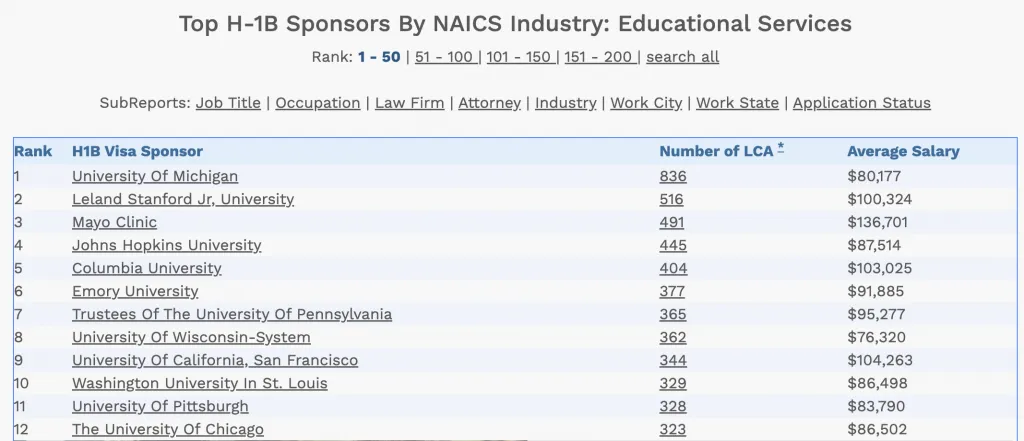
This is the “academics stay at the university” extension strategy, because these numbers include applications for professors, research assistants and other staff.
So it’s more accurate to subtract the number of new faculty hired that year and look at the proportion of total staff. For a more detailed search, look at “how many positions the institution got approved that year” or “how many positions are open now,” and you can estimate which professor or position gives you a better chance.
For the details of what an institution got approved in a given year, here’s Michigan as an example: https://www.myvisajobs.com/h1b/search.aspx?ST=Certified&Y=2023&CI=571882
You can see that postdocs make up most of it. If you don’t have a PhD, you can at least aim for Research Lab Specialist Associate. The data tells you which way to go.
| Job title | Approved |
|---|---|
| Postdoctoral Research Fellow | 173 |
| Assistant Professor | 50 |
| Research Investigator | 34 |
| Research Lab Specialist Associate | 23 |
| Clinical Assistant Professor | 15 |
| Assistant Research Scientist | 14 |
| Research Lab Specialist Intern | 11 |
| Research Area Specialist Intern | 7 |
Another route to the US is to first get citizenship in a country with visa access, like Canada or Australia, and then go to the US on a TN or E-3 respectively. See the Canada and Australia sections (still being written).
There’s also the most extreme way to “get a work visa”: consider moving to the Marshall Islands or Palau. After five years you can naturalize, get a passport, and then work in the US without a visa.
This privilege exists because the US carried out large-scale nuclear tests near the Marshall Islands around 1950. To compensate (officially, at least), the Compact of Free Association was signed in the 1980s, allowing citizens of the Federated States of Micronesia, the Marshall Islands and Palau to work in the US without a visa.
I call it the most extreme way to “get a work visa” because the agreement only lets you enter and work in the US without a visa. You still have to go through the normal process for a green card or US citizenship (if you want one).
Because of this privilege, there was a lot of passport selling in these three countries, so a new condition was added: citizens by birth have no restrictions, but naturalized citizens must live there for at least five years (also five years if you go through a partner visa).
If you or a friend is doing military service or preparing for alternative service (in Taiwan, men do compulsory service, and some can serve in a civilian alternative program instead), our diplomatic service and alternative service programs currently include Palau and the Marshall Islands as options.
I have friends who’ve spent time in both countries, and I imagine life there is simple and unadorned. Honestly, I don’t think the return on investment is very good. You’d do better getting Canadian citizenship and using a TN, or Australian citizenship and using an E-3. At least those two countries have more land to go explore :p
But if you love the ocean, it’s a place where you can dive every day.
I’ll add other countries over time.
Summary
The visa is a challenge no cross-border job seeker can avoid. But by understanding each country’s visa policies and using different routes flexibly, you can greatly raise your interview rate and your chance of an offer.
Preparing early and taking the initiative are the keys.
I hope this guide gives you real help on your path to a job abroad.