
How Much Time to Spend on Your Job Search: Use Your Data to Diagnose Where You Are and Reallocate Your Hours
Time is limited. When you’re job hunting, deciding how much time to spend on job search tasks, and which tasks deserve it, is always a challenge. You need a systematic, evidence-based method to put your hours where they count.
This article builds on the Data-Driven Job Search method from the previous article. I’ll use contributors to look at the key metrics (applications, response rate, interview rate and offer rate) and show how to adjust your strategy and your time so you reach your job search goal more effectively.
Deciding how much time to spend on job search tasks
A common situation
“I know these four metrics. Now what? How do I know which way to go?”
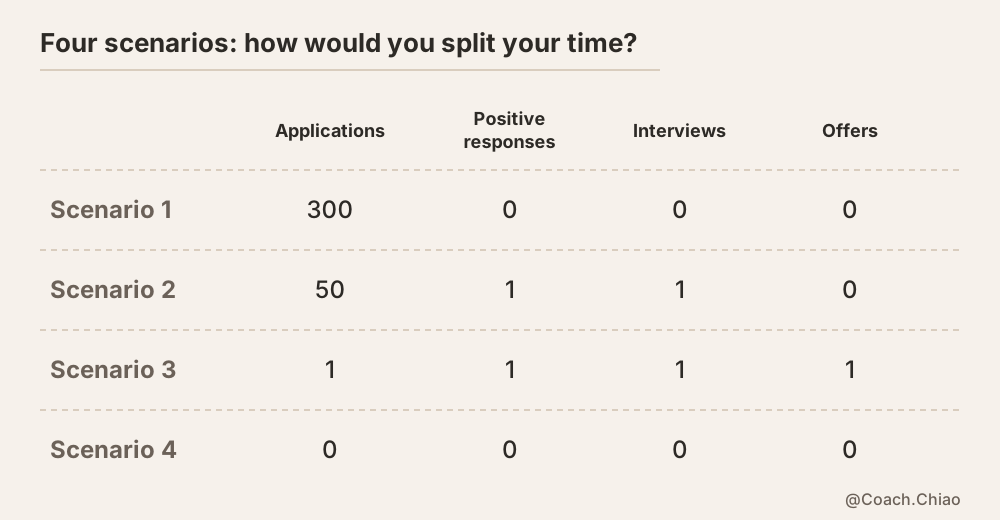
As before, here’s a quick exercise first. We’ll compare notes at the end.
You’ll probably notice that each scenario already hints at how to split your time.
If not, I’ll go back and rewrite this. 😂
Where you can actually make a difference
We always want to be more effective. But when we say we want to “optimize,” where exactly can we push? Look at what you put in (Input) and what you get out (Output), and tie them back to what produces the best result (Outcome).
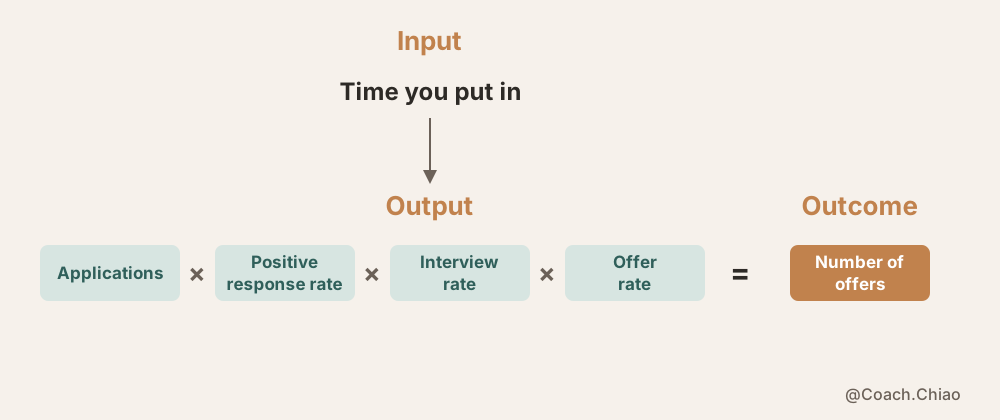
The four metrics from the previous article are a kind of Output, and the number of offers is the Outcome. The Input is your time, so the main question is how to allocate it well.
Here I want to stress two key ideas: contributors and the job search pipeline.
Analyze contributors to find where to push
Each metric contributes differently to the final result. Find the stage that most needs work, look at the possible contributors at each stage, and pick the one that takes the least effort for you. That’s how you get twice the result for half the work.
Picking the right contributor makes your effort count. For example, if you notice that every positive response came from a tailored resume, you’ll want to spend more time there (I’ll cover how to turn this into a few main templates later). Keep writing resumes that match the job description (JD), and you’ll see your response rate climb to a certain level.
A contributor isn’t always something you can act on. A common contributor to the interview rate is “Do you need visa sponsorship?”, and it’s usually the biggest blocker. If you don’t need sponsorship, up to 50% of positive responses can turn into interviews. If you do need it and don’t have it yet, that can drop to 10%. Some countries let you use a working holiday visa strategically, which we’ll talk about later. But that also takes time, so it’s something you can’t change in the short term.
The job search pipeline: raise your success rate step by step
As I mentioned in the previous article, from the job seeker’s point of view these four metrics are a series of gates, one after another. The whole process is like a pipeline. What makes this pipe special is that every stage always loses some water (opportunities).
Our goal is to get more water into the next stage. There are two main strategies:
- Increase the flow: raise your application volume while keeping your response rate and interview rate at a steady level. Even if retention and conversion are low, if you keep applying you’ll still get an offer.
- Increase the conversion rate: keep your application volume the same and raise your response rate and interview rate. You get an offer this way too.
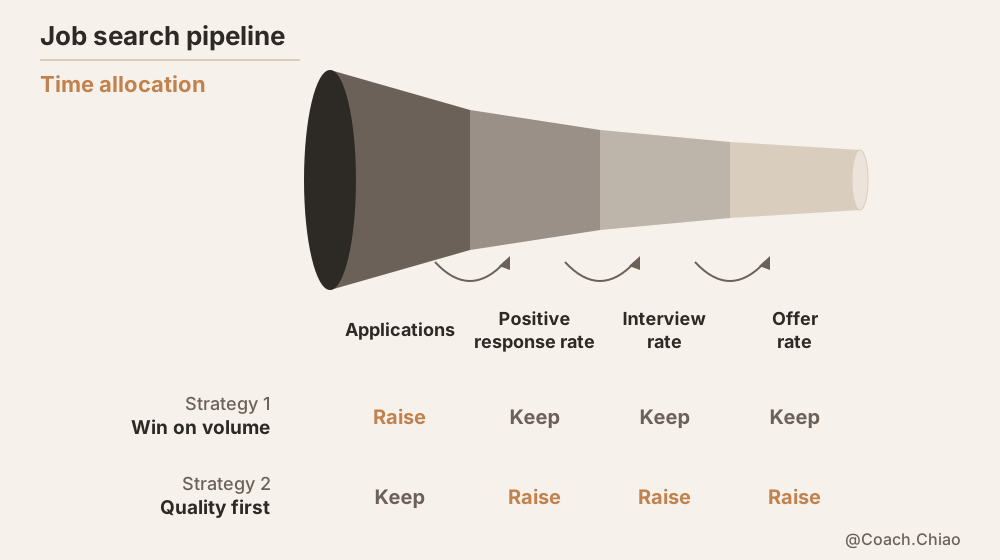
In other words, to land an offer you could send 10,000 applications with conversion rates of 1%, 10% and 10% at the next stages. Or you could send a little over 1,000 with conversion rates of 3%, 10% and 30%.
The end result works out about the same, but the time it takes and how much optimization it needs are very different.
I usually suggest “get something first, then make it better”: first try different combinations to build up quantity (Strategy 1), then improve quality (Strategy 2). Be mentally prepared that early positive responses and interviews often go nowhere. But building up experience so both your quality and your volume hold up gives you a better chance at an offer in the long run.
So here’s what I recommend:
- Before you’ve landed a single interview, keep testing and improving your positive response rate: your resume and how you apply. See which combination gets the best response rate.
- Before you’ve landed a single interview, don’t spend much time on interview prep, including grinding coding problems. Keep a little practice going to stay sharp, but the focus right now is building up the flow at the top.
- Once your positive response rate is consistently above average (covered in the previous article), keep your current best application strategy and keep shifting your time to interview prep.
Job search time management, step by step
So how do you actually use this?
Put the two ideas together and you get this combination:
- Collect different ways to improve each stage (contributors). For the positive response rate, these include how you write your resume, LinkedIn coffee chats, cover letters, referrals and cold emails.
- First raise the volume at that stage, but record which contributors you used for each job. If one converts better and beats the average, keep using it. For example, if you find cover letters help your positive responses the most, keep up the volume and add cover letters, then figure out how to cut the time they take.
- Repeat, improving each stage the same way until the metrics go up.
Next, here’s how to improve each metric in detail.
Applications (Submission)
Definition: how many jobs you applied to.
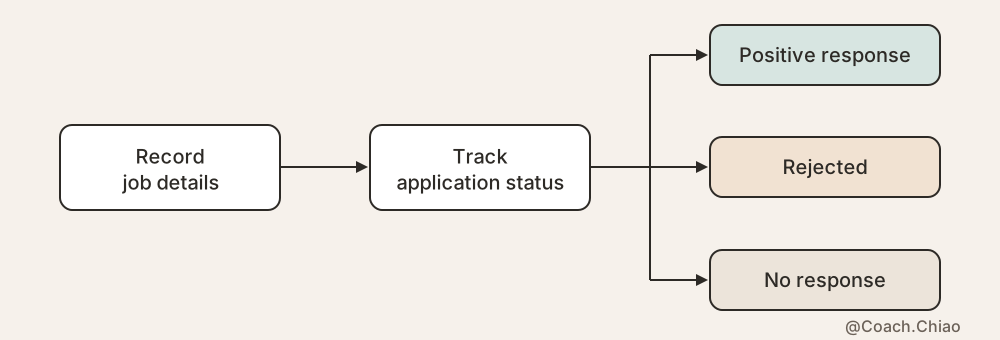
Applications are the foundation of everything. Here’s what I suggest you record:
- Job details: for every application, record the job title, company name, application date and job description (JD). Keeping the JD helps you prepare specifically before an interview, and if the posting has been taken down, your saved copy comes in handy. You can organize this in a spreadsheet (like Google Sheets), or simply press Ctrl + S to save the web page.
- Response status: mark the status of each application, such as “positive response,” “rejected” or “no response.” Recording when you were rejected also helps you judge how well your resume works. If you use a job platform (like LinkedIn or Indeed), some platforms, such as 104 Job Bank in Taiwan, show how many times your resume was opened. That number is well worth recording too. If it doesn’t convert well, your resume needs another round of edits.
💡 Tip: I collect rejections because if you never get a positive response, rejections (within a day to a week) can serve as a signal. A response within a week usually means someone saw your application. Within a day, there’s a good chance the system screened you out automatically. By two weeks, other candidates have usually moved on to the next stage.
Positive response rate
At this stage, the employer checks your basics, including your core qualifications and past experience. They also check your candidacy, mainly whether you need visa sponsorship.
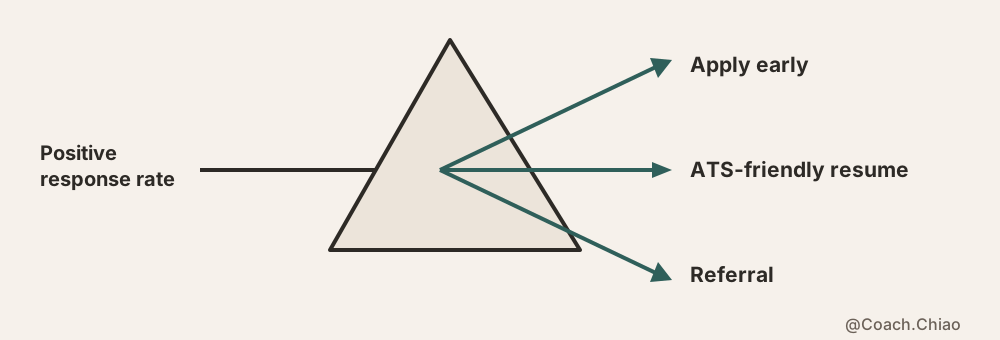
Contributors: the positive response rate usually depends on:
- Applying early: applications sent within a week of a posting going live usually make the first round of interviews.
- A resume tailored to the job: your resume has to get past the ATS (applicant tracking system) and the recruiter, which basically means the content has to answer the JD.
- Getting a referral: a referral from the right person can also raise this number effectively.
- Other materials: recommendation letters, cold emails, portfolios and so on.
Interview rate
How many of your positive responses turn into actual interviews.
Contributors:
- Whether you need visa sponsorship: many recruiters lose interest when they hear you’ll need visa support, since candidates who don’t need a visa can onboard faster with less hassle.
- English level: this is usually the first time you deal with a real person in English. If you don’t do well even in the phone screen, it’s harder to get to the next round.
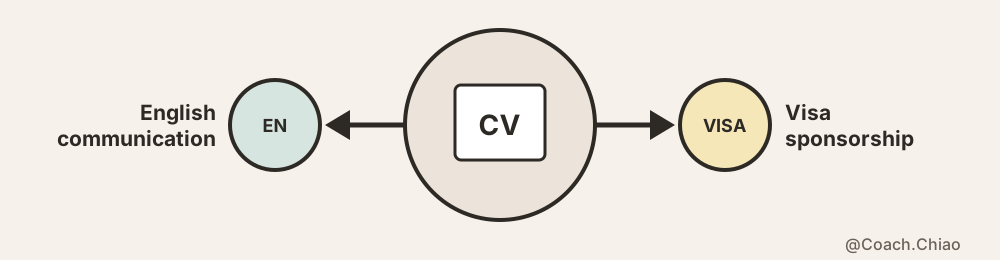
After a positive response, the next step is usually interviews, split into behavioral questions (BQ) and technical questions. After each interview, I suggest writing down the questions they asked so you can analyze them later.
Offer rate
The share of interviews that end in an offer.
To raise your offer rate, the key is improving how you perform in interviews. Look for the common sticking points and bottlenecks across your interviews and strengthen those areas.
What you need isn’t to be good at everything. It’s knowing how to answer what the interview asks. Focus on strengthening the communication and technical skills the interviews call for.
Contributors:
- Technical skills: mostly hard skills (algorithms, data structures, programming language syntax and so on).
- Communication skills: more about soft skills, including word choice and how you make your thinking clear to the interviewer. Your English is part of this too.
- Culture fit: how well your stories fit the company’s culture. Amazon, for example, has 16 Leadership Principles. They won’t test all of them, but if your BQ answers cover the few that matter most, your chances go up. The company’s official website usually lists the culture keywords it cares about.
Back to the opening exercise
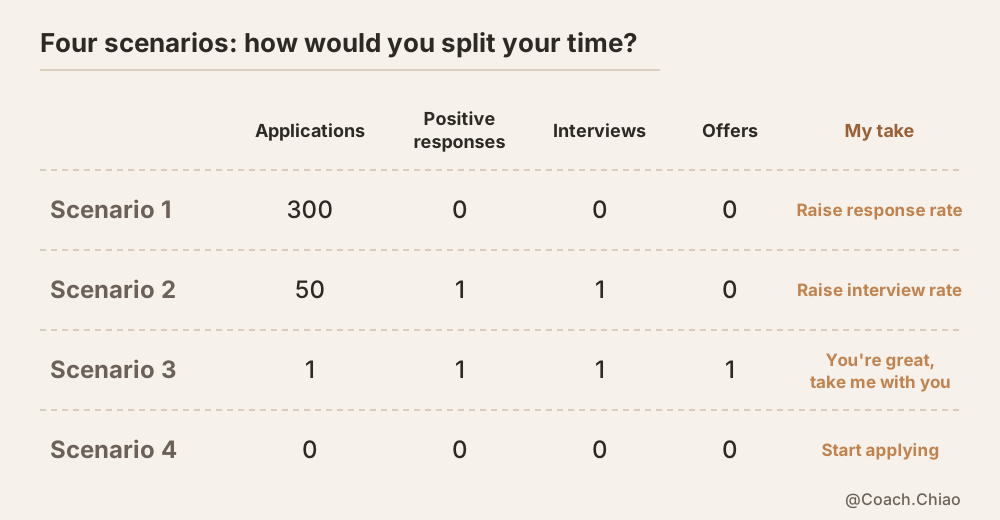
For the four scenarios at the start, assume you’re still applying for entry-level jobs in the US. Here’s how I see them:
- Scenario 1 is about raising your response rate.
- Scenario 2 is about raising your application volume and starting interview prep.
- Scenario 3 is rare. If it happens to you, you probably know someone senior at the company, and I’d like to meet you and ride on your coattails.
- Scenario 4 usually means unlimited potential. Start applying now.
Summary
Time is the most valuable resource in your job search. By tracking your data and quantifying your job search, you can diagnose where you are, find the stage that most needs work, and reallocate your time based on the key metrics.
Whether it’s sending more applications, raising your response rate or preparing better for interviews, this systematic approach helps you reach your job search goal more effectively.
On the long road of a job search, using your time well and putting effort exactly where it counts will bring you closer to the job you want.
About the author
If you’d like to keep following along, stay tuned for the rest of this series.
A little about me: I’m Coach Chiao (George), a career coach. I’ve spent more than ten years on facilitation and coaching, with over 3,000 coaching hours and 700 workshops.
I moved from Taiwan into an overseas career and received several offers, including roles at TikTok in Singapore, Mozilla in the UK, and GitLab in the US. In the end, I chose to join Amazon in the US as a software engineer. I later turned what I learned during that job search into a complete framework you can follow. Since 2021, I’ve helped more than 180 mentees (SWE/PM/DE/BA) land offers abroad within nine months, and I specialize in using data to support your job search.