
How to Write Resume Bullet Points With Metrics: Mirror the Job Description and Quantify Results to Pass ATS
Why resumes matter so much
In the previous article I covered the basics of raising your resume’s response rate: “mirror the wording” and “quantify your achievements.” Some readers asked for more detailed steps, including how to write resume bullet points with metrics, so here they are.
The first step in a job search is writing a resume that catches a recruiter’s eye, and that is often what gets you to the next stage. As I said before, from the Data-Driven Job Search point of view, a resume that gets a positive response is a “good” resume.
This article focuses on two hands-on techniques, mirroring the wording and quantifying achievements, to help you put them into practice and raise your resume’s positive response rate.
How ATS works
Before the specific techniques, let’s look at how an ATS (applicant tracking system) works. An ATS is software many companies use to manage candidate data. It can automatically screen, rank and manage large numbers of resumes.
An ATS usually filters for the candidates who best match the job requirements, based on factors like keywords, skills and experience.
What an ATS does
- Keyword screening: The ATS scans your resume for parts that match keywords in the job description (JD). If your resume contains enough of them, the system decides your qualifications fit the role and recommends your resume to a recruiter.
- Scoring and ranking: Some ATS platforms score each resume based on how well its keywords match, how often they appear and where. Recruiters look at the high scorers first.
- Automatic rejection: If your resume is missing key skills or experience, some ATS platforms may reject it automatically, and a recruiter never even sees your application.
The limits of an ATS
- Limited understanding of meaning: Most ATS platforms can’t understand complex language or synonyms. They rely mainly on exact keyword matches, so if you don’t use the same words as the JD, the system may overlook you.
- Strict format requirements: An ATS has certain format expectations. Complicated layouts, tables or images can stop it from reading your resume correctly.
Tip: It’s fine for your resume to be the simplest, most boring version. Overly complex formatting or images can keep the system from reading your resume correctly.
Why mirroring the wording works
- Higher keyword match: Using the JD’s keywords directly helps your resume score a higher match in the ATS.
- Less risk of being filtered out: Avoiding overly creative phrasing makes sure the ATS reads your skills and experience correctly.
- A better impression on recruiters: When recruiters read your resume, they also notice keywords that match the JD more easily, which improves your chances of reaching the next round.
Hands-on techniques for a high-response resume
Mirror the wording
Mirroring the wording is a simple but effective way to make your resume more targeted. The core principle:
Write your resume using the keywords and sentence patterns from the job description (JD).
This not only helps you get through ATS screening, it also lets recruiters quickly see how well your skills match the role.
Step by step
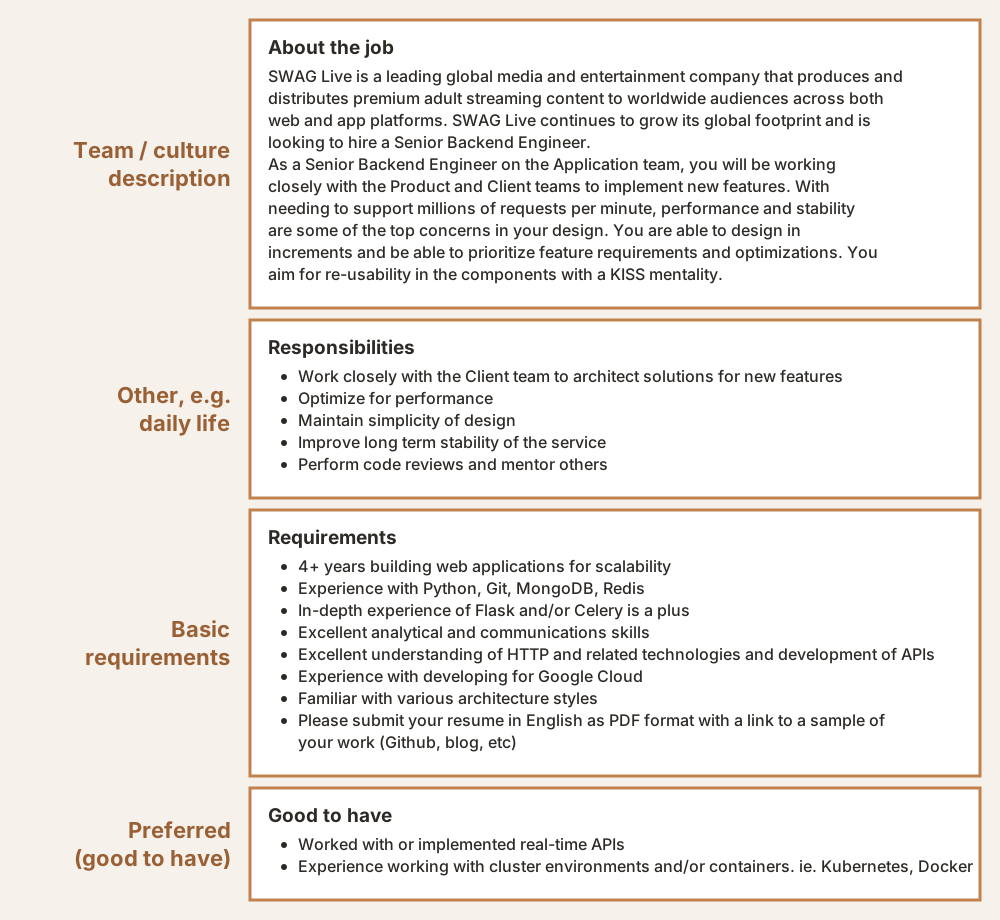
As before, I’ll use this media-industry job as the example (not sponsored). I mentioned its JD last time.
-
Analyze the job description: First, copy the JD into a document and mark the basic requirements and the preferred requirements separately.
The basic requirements are:
* 4+ years building web applications for scalability
* Experience with Python, Git, MongoDB, Redis
* In-depth experience of Flask and/or Celery is a plus
* Excellent analytical and communications skills
* Excellent understanding of HTTP and related technologies and development of APIs
* Experience with developing for Google Cloud
* Familiar with various architecture styles
The nice-to-haves:
* Worked with or implemented real-time APIs * Experience working with cluster environments and/or containers, e.g. Kubernetes, Docker -
Identify the keywords: Find the key skill and experience descriptions in the JD, for example requirements like “4+ years of API development” or “familiar with GCP.” These are the points your resume needs to highlight.
-
Revise your resume with the keywords: Work the JD’s keywords into your resume. For example, if the JD asks for “API development,” you could write:
“Developed and maintained multiple RESTful APIs in the XXX project, used in high-traffic environments.”
A line like this matches the JD and also quantifies your achievement.
At this step, don’t worry if it sounds the same as the JD or a bit plain. The point of “mirroring the wording” is to get something down first and make it good later.
| JD requirement | First draft of the resume line |
|---|---|
| Experience with Python, Git, MongoDB, Redis | Experienced with Python, Git, MongoDB and Redis, used extensively in past projects. |
| Excellent understanding of HTTP and related technologies and development of APIs | Deep understanding of HTTP and related technologies, with API development experience. |
Tip: If your only goal is to get past the ATS, this is more than enough. To catch a recruiter’s eye, though, you need the next step: quantifying your achievements.
- Get help from an LLM: If you’re not sure how to rephrase something, use a tool like ChatGPT. Ask it to rewrite specific parts of your resume based on the JD and make sure the result is ATS-friendly.
Write resume bullet points with metrics: the result-oriented approach
Quantifying your achievements lets recruiters see your impact and ability more directly. For this I recommend the result-oriented approach.
The result-oriented approach is a way of writing your resume that emphasizes the outcomes and achievements you delivered, with a particular focus on measurable results, to highlight your value and your contribution to the organization.
Instead of just describing duties and tasks, it emphasizes how you produced real, measurable results for past employers or projects.
Key features
- Emphasize outcomes: Don’t just list what you did. Highlight what you achieved (your impact).
- Quantify achievements: Use data, percentages, amounts and other specific numbers so your results are concrete and credible.
- Show your impact: Explain how your actions had a positive effect on your team, department or the whole organization.
- Stay relevant: Make sure your achievements relate to the role or industry you’re applying for, and show how you’ll bring value to your future employer.
Techniques for the result-oriented approach
- Use strong verbs such as “increased,” “reduced,” “improved” and “optimized” to highlight your impact.
- Give specific numbers, for example “increased sales by 20%,” “handled 1M requests” or “raised customer satisfaction to 95%.” You can blur a number when you need to (13% can become “more than 5%”), or say you can’t share it (though that does lower your response rate).
- Emphasize results: focus on the end result of what you did, not just the process.
Examples
| JD requirement | Mirrored wording | Quantified achievement |
|---|---|---|
| 1. 4+ years building scalable web applications | 4+ years of experience building scalable web applications. | Led development of 3 scalable web applications handling over 2 million requests per minute, with 99.99% system availability. |
| 2. Experience with Python, Git, MongoDB, Redis | Proficient in Python, Git, MongoDB and Redis. | Built backend services with Python and MongoDB that handle 10 million data queries a day, speeding up data retrieval by 30%. |
| 3. In-depth experience of Flask and/or Celery preferred | In-depth knowledge of Flask and Celery. | Built an API service with Flask supporting 500,000 users; used Celery to implement the OOO technique, improving task processing efficiency by 40%. |
| 4. Excellent analytical and communication skills | Excellent analytical and communication skills. | Led a 6-person team through a 6-month project, delivered on time and beat the target; cross-team collaboration sped up project progress by 20%. |
| 5. Excellent understanding of HTTP, related technologies and API development | Excellent understanding of HTTP, related technologies and API development. | Designed and built 25 high-performance APIs averaging 8 million requests a day, cutting API response time by 35%. |
| 6. Experience developing on Google Cloud | Experience developing on Google Cloud. | Deployed and managed 5 applications on Google Cloud, using autoscaling to cut server costs by 25%. |
Ordering
Another important point is order: both how you order your points against the job’s requirements and how you order your own resume.
As a general rule, the higher something appears, the more important it is. Whether you follow that depends on the story your resume is telling.
But my advice is: the more important an experience is to you, the higher it should go.
Summary
In a job search, the point of your resume is to respond clearly to the company’s needs and show how your skills and experience meet them.
With these two techniques, mirroring the wording and quantifying your achievements, you can write your resume more strategically, get through both the system and the recruiter, and raise your positive response rate.
Whether you’re adjusting keywords to match the JD or quantifying your achievements, these practical techniques help you tailor your resume to each job and make it stand out.
Both take practice, but practice pays off. After about twenty resumes, you’ll have a much better feel for it.