
Which Jobs Should You Apply For, and Which Skills Should You Build? Use Gap Analysis to Raise Your Response Rate Abroad
In earlier articles I mentioned that there’s (almost) no such thing as a perfect-match job. But does that mean every job is worth applying to? How do you know which jobs are worth it and which to skip? This article is about skills gap analysis for job seekers: how to use it to choose where you apply strategically, so you aim at the right targets with more precision.
Gap analysis: choose where you apply strategically
What is gap analysis?
Gap analysis is another key technique. Its goal is to find the gap between you and what a job requires, then close that gap by improving your resume. It’s a strategic way to filter. Especially when you can’t meet every requirement, it helps you focus on your strengths, cover your weak spots and raise your success rate.
Why do a gap analysis?
Think of a baseball hitter. You don’t need a home run on every pitch. You need to know when to aim for the fastball and hit it hard, when to adjust for a borderline pitch, and, for the balls you can’t handle, how to avoid swinging and missing.
This process helps you strengthen specific parts of your resume strategically so your strengths stand out. Even where you can’t fully meet a requirement, you can balance the gap by highlighting your other strengths.
How to do it (quick assessment)
-
List the JD requirements. First, split the JD’s requirements into “basic requirements” and “preferred requirements.” It’s like fastballs and changeups in a baseball game. The fastball is what the employer cares about most, and you have to be able to handle it. The changeup is a bonus: hit it well and you stand out. Using the same JD as an example:
* Basic requirements: 4+ years of API development experience, familiar with GCP (fastball) * Preferred requirements: experience with containers (e.g. Kubernetes), familiar with real-time API development (changeup) -
Assess yourself. Check how well you match each requirement and mark it with a traffic-light system:
- Green (full match): skills you have. For example, “4 years of API development experience.”
- Yellow (partial match): you have some of the experience, but not all of it. Even though it’s not a full match, you have related experience and can point to similar skills. For example, “some GCP experience, but not familiar with Kubernetes.”
- Red (no match): skills you don’t have at all. Treat these like foul balls. They shouldn’t be the focus of your resume, but you can offset them by highlighting your other strengths. For example, maybe you have “no experience with containers at all.”
-
Adjust for the gaps. Improve your resume based on your red, yellow and green lights.
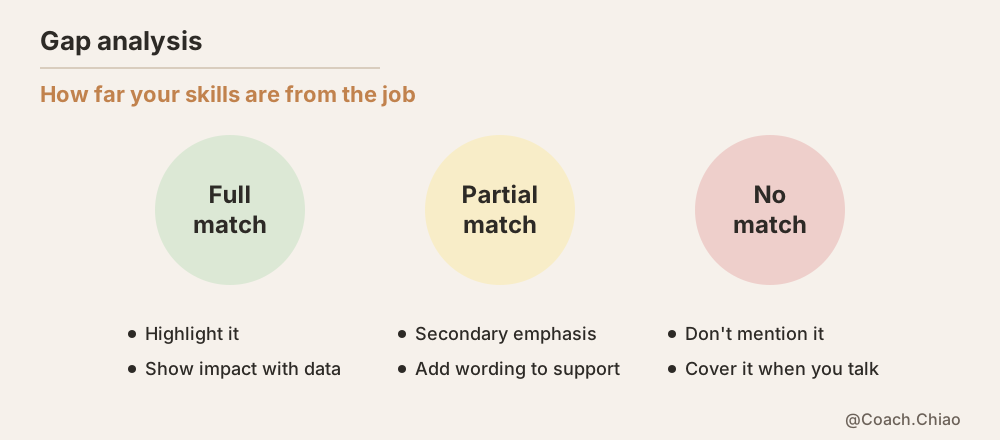
- For green requirements, put them in the most visible spot and back up your results with specific numbers, like showing off your bull’s-eyes in an archery contest.
- For yellow requirements, find related parts of your past experience to fill in. For example, if you don’t have Kubernetes experience but you do have Docker experience, highlight your container skills. That helps ease the hiring team’s doubts.
- Shore up red areas: if some basic requirements in the JD are red and you can’t fill them right away, don’t hide it. Highlight other strengths to make up the gap instead. For example, if you lack container experience, highlight your strength in API development, or show that you pick up new technologies quickly.
A gap analysis example (quick assessment)
Say you’re applying for a Senior Software Engineer role. The JD asks for 4+ years of API development experience and familiarity with GCP and Kubernetes. Here’s how the gap analysis works:
-
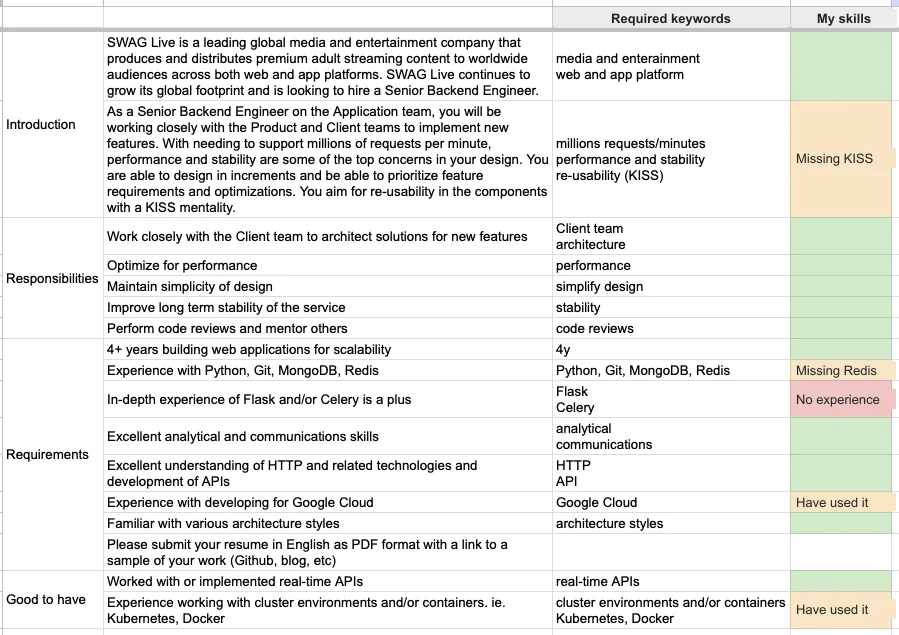
Copy the JD. Paste the JD into a document and mark the keywords, such as “4 years of API development,” “familiar with GCP” and “Kubernetes experience.”
-
Assess yourself. Say you have 4 years of API development experience (green), basic hands-on experience with GCP (yellow), and no Kubernetes experience (red).
-
Adjust your resume.
- API experience: highlight the API projects you owned at past companies and quantify the results, for example “Designed and built 10+ APIs at XYZ, handling 500,000 requests per month.”
- GCP experience: you only have basic GCP experience, but you can highlight how quickly you’ve picked up these technologies before, and list the specific things you’ve done on GCP.
- Kubernetes (red zone): when you can’t fill the gap directly, highlight related experience instead, such as “Managed Docker containers, with a basic understanding of containerization,” to show you can learn container technology.
Advanced skills gap analysis for job seekers: find your weak spots across many job descriptions
Once you’ve used gap analysis to screen and adjust for individual jobs, an advanced analysis gives you a fuller picture of your strengths and weak spots, so you can improve your resume and job search strategy more effectively.
The advanced analysis cross-compares multiple jobs, finds the key skills that keep coming up, and systematically fills your gaps.
This part isn’t only about your response rate anymore. It’s more about your interview rate. So in the advanced analysis, you weigh which skills are worth the time to build, and you think about how interviews will test them. If they’re likely to test hands-on work, study harder and focus on practice. If they test concepts more, at least make sure you can explain those concepts clearly.
Why do an advanced analysis?
If gap analysis is a precise swing in a single game, advanced analysis is the full-season stats review. By looking at the overall trends, you find which skills the market asks for most and which ones you’re missing again and again.
An advanced analysis lets you:
- Target your weak spots. After analyzing many JDs, find the “red light” skills you keep running into across different jobs. Those are your weak spots. Learn and build them first so you stand out the next time you apply.
- Spot market trends. When you analyze JDs for similar roles many times, you start to see trends for those roles. These trends help you understand what the industry needs and adjust your learning path.
- Become more competitive. Advanced analysis doesn’t just show how well you match one job. It reveals the common skill requirements across the job market, which helps you improve your resume and compete better.
- (Potentially) build templates. Once you’ve sent enough applications, you’ll know which kinds of jobs can use which resume, and iterate quickly. After several gap analyses, you can match each JD to one of your resume templates much faster.
Advanced gap analysis, step by step
1. Collect multiple JDs
First, pick several jobs that interest you and fit your background, and gather their JDs. The key is to cover the same field or similar roles (for example, Senior Backend Engineer at different companies), so you can analyze which skill requirements show up again and again.
2. Extract the common keywords
Compare the JDs you collected and pull out the keywords and requirements that keep repeating. For example, across ten Target Job postings for backend engineers, you might find these skills are common requirements:
- API development: appears 10 times
- Cloud technology (e.g. AWS, GCP): appears 9 times
- Container technology (e.g. Docker, Kubernetes): appears 8 times
- Database management (e.g. MongoDB, PostgreSQL): appears 6 times
Put these key skills in a table and note how often each one appears across the JDs. It’s like batting analysis in Major League Baseball: find the fastballs and changeups you face most often so you can prepare precisely.
As I was writing this, Shohei Ohtani had just made history with his 51-51 season. Huge congratulations. Ohtani is amazing, but each of us has our own batting average and our own field. You can admire and learn from him, and still put your energy into the track in front of you.
3. Check how well you match and find your weak spots
Next, assess yourself against each common skill and see how well you match. Use the traffic-light system again:
- Green (full match): skills you’ve mastered and can clearly show on your resume.
- Yellow (partial match): you have some related experience but not much depth, or you’ve studied it but haven’t used it in a real job.
- Red (no match): skills you don’t have at all, or have very limited experience with.
It’s a bit like reviewing a hitter’s swing chart to find the pitch types they keep whiffing on. Those are exactly the weak spots you need to work on.
4. Make a plan to close the gaps
Based on your weak spots, make a specific plan to close them. One factor here is “provability”: how well you can answer when an interviewer asks about it. Options include:
- Join a project. If you’re sure this is a direction you want to build on long term, join a project. Besides finding repos on GitHub or teaming up through community groups, you can look for open issues at g0v, Taiwan’s civic tech community. This takes the most time, but it also gives you the highest provability and the most learning.
- Take a course. If you find that Kubernetes or Docker is emphasized in most JDs and you happen to lack it, take a related online course or earn a certification. The time cost is moderate, provability is decent, and how much you learn depends on the situation.
- Build a personal project. If you haven’t used certain technologies at work, you can design your own projects to cover those gaps. For example, if many JDs ask for cloud technology, try deploying one of your past projects to AWS or GCP to show you can actually use these platforms. The time it takes varies, provability is low, and how much you learn depends on the situation.
- Learn to talk about it. Once you’ve found a weak spot, learn the key terms of the new skill and work them into your stories. This is the last-minute cramming option, and I only recommend it right before an interview. It takes little time, but provability is low and so is the learning.
| Approach | Expected time | Provability | Learning |
|---|---|---|---|
| Join a project | High | High | High |
| Take a course | Medium | Medium | Depends |
| Personal project | Varies | Low | Depends |
| Learn to talk about it | Low | Low | Low |
5. Review and update regularly
Advanced analysis isn’t a one-time thing. It’s an ongoing process. As you keep applying and getting feedback from the market, regularly review new JDs, update your skill demand analysis, and keep closing your gaps.
It’s like a team during the season: they keep updating their stats and adjust their strategy for each opponent.
Advanced analysis is the strategy you need to get into the job market’s “league.” By analyzing from multiple angles and building yourself up, you can hold your ground in a competitive market. Through this process, you systematically find your weak spots, plan exactly how to close them, and finally hit your target.
Summary
Gap analysis and advanced gap analysis are two essential methods in a job search.
Gap analysis helps you quickly assess how well you match a job and close the gaps by improving the key points on your resume, like a hitter adjusting the swing for fastballs and changeups.
Advanced gap analysis goes deeper. By cross-comparing many JDs, you systematically find what the market commonly asks for and build up what you’re missing, like a precise tactical review of a season’s stats, so you can raise your competitiveness over the long term in a more targeted way.
Use the two together. They help you make the most of your strengths in each application and build real ability over time, so you stay ahead in a competitive job market.
If you’d like to keep following along, stay tuned for the rest of this series.
A note: Gap analysis isn’t only about finding what you lack. More importantly, it’s about strategically building on your strengths so your resume stands out from the crowd.