
How to Start Applying for Jobs Abroad: Test the Waters, Build Volume, and Sort Roles into Dream, Target and Acceptable Jobs
When you start looking for jobs, you often can’t find one that feels “right.” Your skills don’t match what the company wants, or the other way around. Sometimes you spend so much time on your early resumes that you miss the window when a role is fresh. Or you never feel good enough or qualified enough, so you don’t apply at all.
This article is for people at the very start of their search, especially if you’re working out how to start applying for jobs abroad. It covers the mindset and the techniques for getting your first ten applications out the door.
Philip’s story
Philip had just finished his PhD in the US. He’s also a licensed doctor in Taiwan, and he was about to look for his first job. He’d spent a lot of time polishing his resume and searching for roles as close as possible to his research, something like “how a certain drug affects the growth mechanism of a certain protein.”
When I asked how it was going, he said: “It’s hard to find suitable openings. The rare ones that match want more work experience. I’m waiting for something that fits me better. I’m working on my resume and connecting with alumni, and I should have a first version by the end of next month.”
If you were me, what would you tell Philip?
As usual, I’ll share my answer at the end.
Common pain points early in a job search

Early on, most job seekers run into a few of these:
- Preparing for a long time and still not sending the first application
- Spending too much time on each application
- Spending a lot of time searching for a perfectly matching job
- Not daring to apply when the job description doesn’t fully match
All of these are completely reasonable and very normal. It’s especially true when you’re applying into an unfamiliar market, or when life is fine right now and you don’t feel much pressure to apply. That’s normal too.
The Data-Driven Job Search mindset: test the waters

I’m not saying you need to apply in bulk right away. But I strongly suggest starting early and sending a small number. At the heart of the Data-Driven Job Search method (from my book Data-Driven Job Search, or 量化求職) is collecting data as early as possible. I call it “throwing a stone to test the road.” You toss a small stone down a path you’re unsure about, and from the sound alone you might learn the path is unstable, or very deep, or already full of other people’s stones. Or the stone lands with a quick, clear answer, and you learn the path is safe.
It’s also a way to get feedback early. The sooner you have some data, the sooner it can help you decide. If your first ten applications get no response, great: your resume wasn’t finished anyway, and once it is, it’ll knock everyone’s socks off and your response rate will shoot up. Or maybe the resume you think isn’t ready yet already looks like a perfect match to them, or the other candidates are greener than you, and your response rate will be high.
Get something out first, then make it better. Let your first resume go out and draw some fire, and you’ll learn how the market reacts to it.
The core mindset: there’s no perfect match

Once you keep applying, you’ll notice there are a lot of jobs out there. Our skills rarely match a company’s needs perfectly, and a company rarely matches all our expectations either. Both sides are looking for the best fit available right now: the company wants the best candidate it can get at the moment, and you want the best company you can get at the moment. It’s a lot like love.
In other words, no matter how deep or strong your expertise is, it’s hard to find the role (and the manager) that needs your exact expertise right away. But you can jump to the next, better job first and keep waiting for your ideal match (more on this in Technique 2).
One more thing: companies sometimes list very demanding requirements. Personally, I think you can still apply even if you don’t meet all of them (sorry, recruiters!). If I really don’t fit, the applicant tracking system (ATS) will filter me out, or they’ll pick someone else. But if I don’t try, I have no chance at all. When I was job hunting in the US, I saw plenty of people whose qualifications didn’t match that closely, but they tried, and that got them seen.
Later articles will build on this: (1) how to analyze what a job is asking for and write a resume that works for both recruiters and the ATS, and (2) how to use the demands you see across many job postings to map the gaps in your current skill tree and plan your time.
Sorting jobs: Dream, Target and Acceptable

If you struggle to divide your time, ranking the jobs you’re aiming for matters a lot. I suggest sorting them into three types: Dream Job, Target Job and Acceptable Job.
| Type | Description | Strategy | Time on the resume |
|---|---|---|---|
| Dream | Your ideal job. Maybe remote, maybe a big company like FAANG | Whatever it takes; don’t cap your prep time | < 5 hours |
| Target | The roles you’re aiming for. Maybe a mid-size company or one with a distinctive culture | Prepare properly | < 30 min |
| Acceptable | Jobs you’d accept. Most other companies | Just send it, with light tweaks to your existing application kit | < 5 min |
A few things about this system:
- Everyone’s Dream, Target and Acceptable lists will be different. Google might be the holy grail for some people, while for others it’s a remote-friendly company like GitLab. Your categories come from your own decision criteria. I’ll write a separate piece on how to figure those out.
- Order: early on, I usually suggest sending your Dream Job applications first, then the Acceptable ones. Only once you accept that you can’t win over your dream crush do you get serious about life down here among us mortals. Unlike love, though, a Dream Job usually opens up again. At big companies the same kind of role may come back within a month or two, and you can try again then.
- We all need to get something first. Job hunting is a long road, and going a long time without any response makes you wonder whether you’re on the right path. Start by firing off Acceptable Jobs quickly. The emotional cost is lower (no big deal if it doesn’t work out), and in theory they should bring in more positive responses.
Disclaimer: this mindset is merely a lot like love. It is not dating advice of any kind. Please treat your own true love well.
Techniques for how to start applying for jobs abroad
That’s the mindset. Now let’s get into the practical details: the techniques.
Technique 1: Throw your first stone with Easy Apply
Sending the first application is usually the hardest part. Once it’s out, it’s worth celebrating all night.
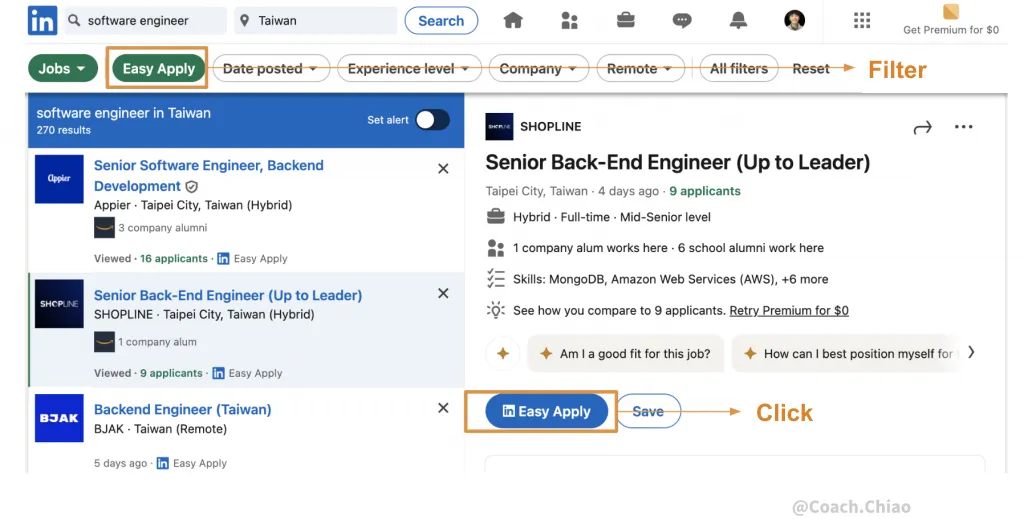
At this stage I usually suggest using LinkedIn’s Easy Apply to send out a few Acceptable Jobs. Here are the steps:
- (1 min) Search LinkedIn for the jobs you want in a given location, and turn on the Easy Apply filter.
- (30 min) Copy the job description into any LLM you trust, add your experience, and ask it to help you generate a resume.
- (5 min) Fill in your basic details and send the resume you have.
The first one usually takes longer. After that, you can reuse the same resume or simplify step 2, and send several Easy Apply applications within a week to see what kind of response rate you get.
That way you get the market’s feedback on your experience (your resume) as early as possible. Even if your chances at those particular jobs aren’t high, it never hurts to make a connection with a recruiter, and meeting people and practicing interviews is good for you too.
Here are some advanced (dark arts) tools: bots that send Easy Apply applications automatically.
- https://github.com/voidbydefault/EasyApplyBot
- https://github.com/feder-cr/linkedIn_auto_jobs_applier_with_AI
I don’t recommend using them too early. Especially at the start, going through the job requirements yourself and matching them to your resume is an important process. You see every job with your own eyes, you learn what the market wants and which gaps you need to fill, and you get a better sense of what your current skills are worth in the market. Also, both bots need extra setup, so you’re better off quickly sending one application yourself and collecting feedback. I’ll do a full step-by-step walkthrough later.
The baseline response rate for Easy Apply is roughly one third of applying through the company’s own careers site, but it’s still a useful reference point.
Technique 2: Use alerts to keep tracking the jobs you love
Some people are very loyal. They have one company they really want to join, or a deep specialty they want to build on (for example, a senior backend engineer for a search engine, or a Scrum Master at TSMC). In that case, let Google Alerts and LinkedIn Job Alerts be your private investigator and keep watch for you.
LinkedIn Job Alert
- Search LinkedIn for the job you want.
- Filter by the company you want, for example GitLab.
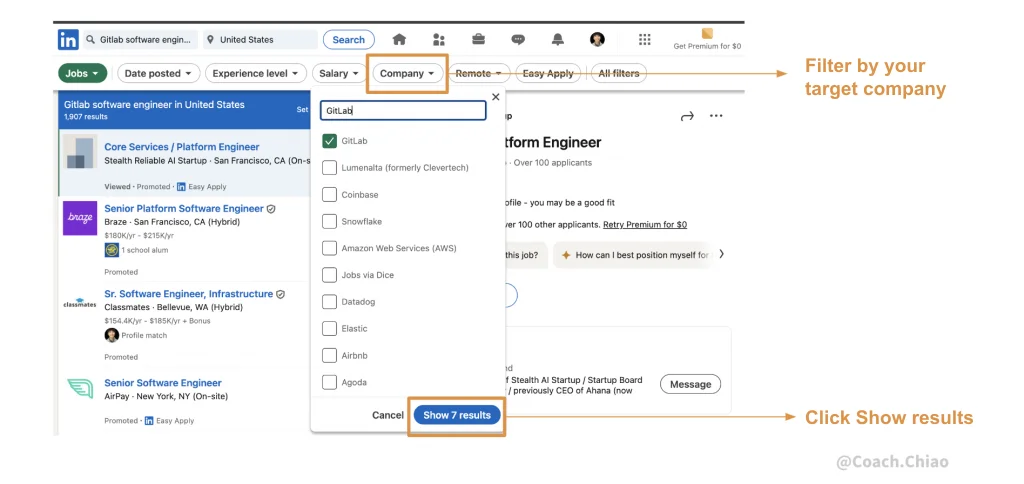
- Turn on Set alert.
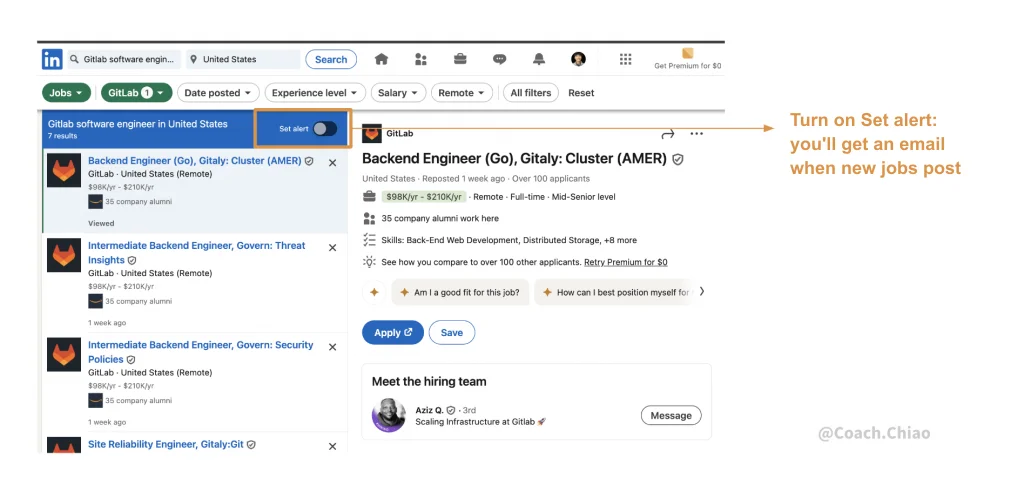
Google Alert
Search for Google Alerts and you can enter keywords for Google to search automatically on your behalf. Say you’re interested in engineering jobs at a restaurant group, such as Wowprime (one of Taiwan’s largest restaurant groups). Once you set it up, Google emails you whenever 104 Job Bank (Taiwan’s biggest job site) or Wowprime’s own website posts something new.
You can filter by a few conditions:
- Sources: news (Google News), web pages, videos and more
- How often to email you: as it happens, once a day, or once a week
- Region: the United States, Hong Kong, the United Kingdom, Taiwan and so on
- Which language of results to track
Then have the alerts sent to your inbox. If you use RSS, you can also follow them as an RSS feed (I use Inoreader, happy to compare notes).
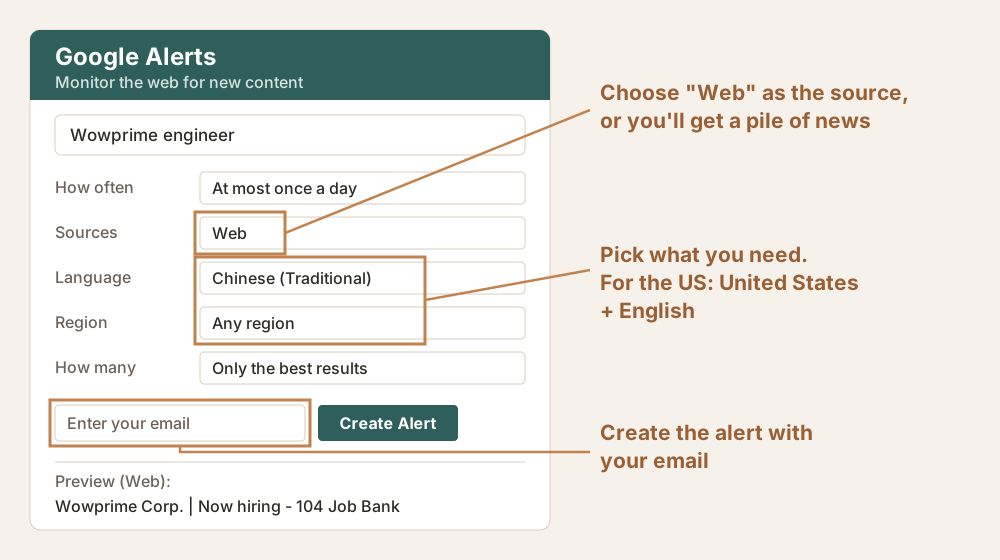
Tip 1 (important): To keep your keywords from pulling in entertainment news (Google News), I strongly suggest choosing only Web as the source. That makes it much more likely the results are the jobs you’re targeting. That’s the setup I used for my own keyword alerts sent to my inbox.
Tip 2: Your target job may show no results right now. That’s normal. It just means nothing has been updated recently, so leave it running daily.
Tip 3: Add every company plus keyword combination you’re interested in. You can go all the way up to the limit of 1,000 alerts.
Tip 4: File the alerts into a folder and clean it out on a regular schedule.
For jobs like these, I also think it’s well worth connecting with people on the relevant team. Even if the role isn’t open yet, a coffee chat helps you understand how the team is doing, you can get feedback on your resume, and later you can ask them for a referral. For connecting, start with LinkedIn and ADPList. I’ll go into the details later.
Back to the opening exercise
So, back to the question from the start: Philip has a Dream Job, and he’s waiting for a role that fits better. Here’s what I’d suggest:
- Use Technique 1, Easy Apply, to send a few resumes and see what the market looks like.
- Use Technique 2 to track his Dream Job.
- Then connect with people who work in those roles.
Summary: an international job search strategy from day one
Early in a job search, many people get stuck. They can’t find suitable openings, they spend too much time on their resume, or they wait for the perfect job and never apply. Philip’s story shows that you should start applying as early as possible. Even if things aren’t perfect, testing the waters gets you real feedback from the market.
The core mindset: there’s no perfectly matching job, so get something out first, then make it better. Sort jobs into Dream Jobs (your ideal), Target Jobs (what you’re aiming for) and Acceptable Jobs (what you’d accept), and use a different application strategy for each type.
Practical techniques:
- Use LinkedIn Easy Apply: apply quickly to Acceptable Jobs and collect the market’s response.
- Set up job alerts: use LinkedIn Job Alert and Google Alert to keep tracking new openings for your Dream Job.
In the end, taking the initiative, acting early and connecting with people who do the work can really raise your chances of landing the job you want.