
The First Round Abroad: How to Answer "Tell Me About Yourself," Work Experience and Motivation as an International Candidate
Why the screening stage matters
Your “tell me about yourself” answer as an international candidate is often the first thing a foreign recruiter hears. The screening stage is the main gate to the interview. A recruiter uses a set of screening questions to make a first assessment of whether you fit the role. Behind every question there is a “goal,” and usually a “main goal.” That’s why a good answer starts from what the recruiter is trying to find out.
What I want to stress here is how to answer so you get to the next round. Understanding the goals helps you answer more efficiently and raises your chance of passing the screen.
This article goes through the questions by category and gives you concrete answer suggestions and things to watch, so you can keep control of the pace in a real screening call.
Before the details, let’s look at the goal of this stage. Everything below comes from the Data-Driven Job Search point of view: how to raise the success rate of this stage. Success at screening means reaching the interviews, which in the data is your interview rate.
Put simply, you need to “answer what they need.” My high-level advice: for every job at Target level or above, make a table like the one below for these questions, think about what the other side needs, then answer.
Screening questions and their goals
| Screening question | Main goal | Secondary goals |
|---|---|---|
| 1. Self-introduction | Check basic requirements | Verify the resume, test communication skills |
| 2. Work experience | Check basic requirements | Verify the resume, lower the later failure rate, test communication skills |
| 3. Motivation and interest | Understand motivation and culture fit | Lower the later failure rate |
| 4. Skills and qualifications | Check basic requirements | Verify the resume, confirm feasibility, lower the later failure rate |
| 5. Language ability | Test communication skills | Check basic requirements |
| 6. Timeline | Confirm feasibility | Check basic requirements, verify the resume, understand motivation and culture fit, lower the later failure rate |
| 7. Visa and work permit | Confirm feasibility | Check basic requirements |
| 8. Salary expectations | Confirm feasibility | Check basic requirements |
| 9. Culture fit | Understand motivation and culture fit | Test communication skills |
Below I go through how to use this table in more detail.
1. The “tell me about yourself” answer for international candidates
A good start is half the battle, and the first impression usually comes from your screening call self-introduction. The recruiter has probably heard thousands of them, so my advice is to “summarize your experience briefly” and “answer their needs,” focusing on your professional background and the experience related to the role.
Remember: the recruiter wants to confirm you have the basic skills and experience, and at the same time is judging your communication.
Main goal
Check that you meet the basic requirements. Stress the experience most relevant to the job description (JD) so your basic qualifications clearly meet the bar. Don’t be in a position where they want three or more years of a skill and you can’t even put together an answer.
The key here is a summary aimed at their “main needs.” The steps:
- Identify the “main needs.” It might be three or more years of work experience, or Web3 experience. There will always be some basic conditions in the JD that need to be met.
- Map your own experience to them and work out how to present (package) it to meet those main needs.
Secondary goals
- Verify the resume
- Test communication skills
Use clear, organized language and avoid flowery or long-winded answers, so you show your resume is accurate and true. The steps can include:
- Keep your resume in front of you as you talk. Tying your experience and numbers back to it helps.
- Before getting to the point, add simple greetings like “how are you” and “thanks for your time today.” Staying polite rarely causes problems.
What to watch
- Focus on their needs: Before your self-introduction, open the JD for that job! Go back to the JD, then stress the experience and skills related to the role. That answers the company’s main goal directly.
- Be credible: Make sure what you say matches your resume and don’t exaggerate. That covers the verification part of the secondary goals.
- Be clear and fluent: Show good communication by using simple, clear language.
Example answer
“I’m [your name], [your most important keyword, ideally tied to the job title], focused on [their most critical need]. At my previous company, I [their next most important needs (at most three is my suggestion)]. I’m very interested in [their product, culture and so on] and would love to contribute.”
For example:
“I’m George. I have five years of backend development experience, focused on building APIs with Python and the Django framework. At my previous company, I led a team of three and improved system performance by 30%. I’m very interested in your culture of speaking up and in your [product], and I’d love to contribute.”
2. Work experience
Here they look in more detail at whether your past experience matches the JD. Prepare specific examples from your work to show your ability, matching the requirements of the role as closely as you can.
The recruiter wants to know whether your past experience can be applied directly to the future job, which lowers their hiring risk.
Main goal
Check that you meet the basic requirements. This is similar to the self-introduction. You could say the first question is the summary, and this one goes into your individual achievements, explaining clearly which need each achievement or story answers.
Secondary goals
- Verify the resume
- Lower the failure rate in later stages
- Test communication skills
The goals are similar to the self-introduction, with one difference: as you walk through the details, the recruiter starts paying attention to how well the behavior in your stories fits the company. Not a lot, but they start to care.
What to watch
- Stress relevance: Describe in detail the experience directly related to the role. If the introduction was the summary, now you quickly walk through your past experiences, again tying them back to the JD’s keywords and needs.
- Quantify results: Use more numbers and concrete cases here to prove your ability, but keep them close to the numbers on the resume you sent.
- Signal that you can do the job: For jobs at Target level and above, think about the problems the team is likely to face at its current stage. Show how you solved similar problems before, which signals you’ll handle the job.
For example:
- A startup team before or around its Series A is usually in a phase of scaling the team and product fast. If you have the bandwidth, prepare stories about that.
- A new product at a large company may run into certain problems. I come from a medical device background, so I could mention regulatory issues they might face.
Example answer
“At [company], I worked as [role or task], focused on [a need from the JD]. The project [some numbers].”
“At my current company, I led a project integrating an external company’s web API, handling more than XXX TPS of requests per month. I led the team through system optimization and cut the application’s load time by 30%.“
3. Motivation and interest
The next common question is about motivation and interest. Here the recruiter most wants to see enthusiasm for four things:
- The company
- The team
- The industry
- The role
The key is to show as much fit as you can with the company, team, industry and role. This is also how the company judges whether you’ll stay long term.
Main goal
Understand your motivation and culture fit. Show that you identify with the company, team, industry or role, and explain specifically how the role fits your career plan. Suggested steps:
- Find information about the company, team, industry and role of the job you’re targeting.
- Pick the part with the biggest fit, or where you’re most distinctive.
For example, if you’ve worked in finance or similar industries, start there and say you’re passionate about it. If you have no related background (say you’re changing careers), you can say the company has strong experience in a certain culture or product, and mention events they’ve appeared at to make a connection.
For example:
- “I saw Eric from your company at AWS Summit, and it made me think you must be a rigorous company that encourages people to keep learning.”
Secondary goal
- Lower the failure rate in later stages
Stress your stability and growth potential, which lowers the risk that you’ll leave later because the culture or career path doesn’t fit.
What to watch
- Answer with your why: Explain clearly why you’re interested in the company and role (your why). If you can connect it to your own values and past stories, it’s usually more convincing.
- Share your long-term plans: Let the recruiter feel your stability and your wish for a long-term relationship.
I usually look at the company’s stage, or check its LinkedIn to see what roles they have. Best of all is finding someone who was promoted from the role I’m applying for, and mentioning that path.
- Match the company culture: Show that you resonate with the company’s values and culture. I usually suggest going to the company website to see what values they care about; you’ll find some keywords there.
For example, WeWork lists its values on its website, and I’d build sentences with those keywords: https://www.wework.com/zh-TW/mission (the Taiwan page, in Chinese).
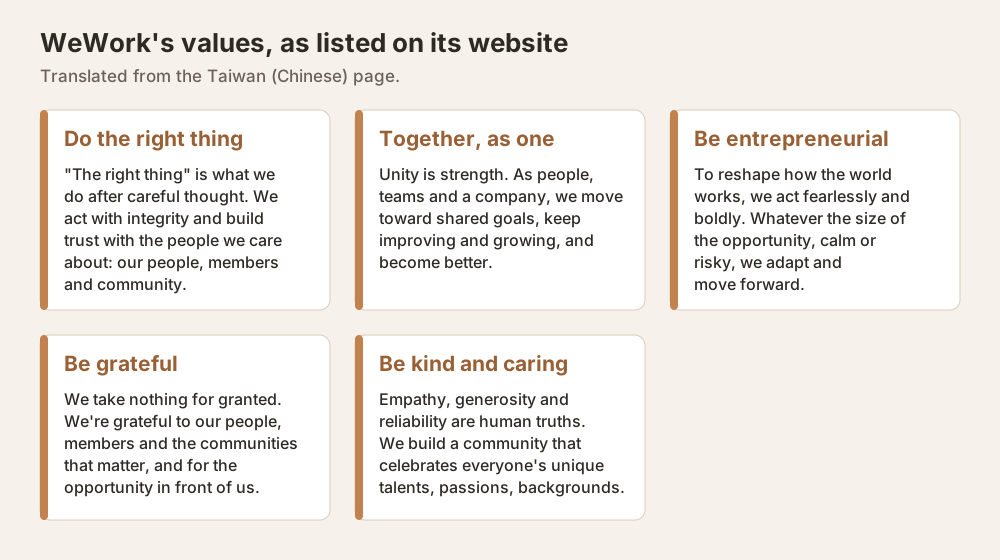
Example answer
“I believe in doing the right thing: considering not only the company’s interests but also the needs of the community and the team. In one project, the testing team hit a technical bottleneck and the schedule was expected to slip. I reached out to the project and testing teams and quickly set up a meeting to understand their situation. We learned that if they broke through this bottleneck, testing would become more efficient afterward and long-term costs would actually go down. So we decided to wait for them, split the feature into phased releases, and prioritized the main business goal, [goal].”
Summary
Understanding the main and secondary goals behind each screening question, and preparing for those goals, can significantly raise your chance of passing the screening stage.
Whether it’s your self-introduction or your motivation and interest, keep your answers focused on the role’s needs, quantify your results and show how you fit the company culture.
These techniques will help you handle the challenges of the job search and move on to the next step: the interviews.