
Is a Referral Always the Best Strategy? Referral vs Cold Application, and How Much Time to Spend on Connects, Cold Emails and Coffee Chats
Why this topic matters
How to split your time for the best results is a challenge for a lot of job seekers. Should you wait for a referral or just apply? In this article I use the response rate to weigh referral vs cold application and the other ways of reaching people, so you can plan your referrals, connections and cold emails more efficiently and improve your application strategy.
After resumes, we come to the most important question in the response rate series: what is the most effective application strategy? Where people usually get stuck is spending a lot of time preparing portfolios and cover letters, hunting for referrals, connecting with people for coffee chats, or joining study groups. The previous article covered portfolios and cover letters. This one focuses on the other ways of connecting with people.
What usually happens
These situations come up all the time in a job search:
- “My referral hasn’t replied yet. Should I just apply?”
- “My connection requests aren’t getting answered. It’s a bit discouraging.”
- “Nobody’s been reading my cold emails lately. Should I keep going?”
- “Today I have a LeetCode study group / conference / job seekers’ group / agile learning circle…”
These are real challenges in a job search. I often see early career changers join lots of study groups or sit waiting on referrals. From the Data-Driven Job Search point of view, all of these actions are “contributing factors.” What matters is which metric each one contributes to most.
- Applications: not much help. Spending time on these tasks doesn’t directly increase how many applications you send.
- Positive response rate: the main benefit, since any of these actions can get you to the next round (screening).
- Interview rate: some help, but less than for the response rate. Even if you reach screening, the qualifications check still matters. Some people do skip straight to interviews because they know someone.
- Offer rate: relatively little help. There aren’t many cases of getting an offer directly through connecting with people. If you can do it, that’s a way of building relationships everyone would want to learn.
Thinking it through, these contributing factors come back to the positive response rate. So next we’ll look at how to use them to raise your positive response rate more effectively. This will help you:
- Clarify the purpose and contribution of each action
- Account for the time invested and the delay before results
You can apply these two steps to any contributing factor.
Connecting with people: referral vs cold application and the options in between
First, let’s split these tasks into “contact” and “action.”
Ways to make contact
- Connect: Usually means adding someone as a connection on a social platform (such as LinkedIn). The interaction is fairly shallow.
- Cold Email: Sending an unsolicited email or LinkedIn message to a company or professional you’re interested in, to express interest, ask about openings or ask for advice. It takes some time, but it can lead to further conversation.
- Coffee Chat: An informal one-on-one meeting with someone in your industry to learn about their experience and views in depth. It helps build a deeper relationship and gather information.
- Study group: Joining a reading group or study group related to your field to discuss and learn with like-minded people. It deepens your knowledge and can build long-term professional relationships. Job seekers’ groups are an extension of this.
All of these are ways of connecting with people, and their purpose is to “get information” or “get recommended.” Ordered by how deep the connection is:
Connect < Cold Email < Coffee Chat < Study group
Correspondingly, the time you spend usually grows with the depth of the connection. But that doesn’t mean the contribution to your response rate grows at the same pace. This article will help you understand that and use it to raise your response rate.
Which “actions” from these contacts raise your response rate?
This sounds a bit transactional. But if the purpose of the connection really is your job search, that clear purpose is exactly what makes it effective. You can make the job search the main goal and meeting people the secondary one, and still pay attention to the key metrics.
Of course, whether or not the job search is your main goal, being genuine and giving back consistently are usually what make a connection last.
Connecting with people raises your positive response rate mainly through:
- Referrals (internal referral or direct recommendation): Someone recommends you for a specific role at their company. From my own experience: one mentee in Canada focused on finding referrals because her positive response rate through them reached 15% (though the total was small, around twenty). A direct recommendation means someone hands your resume straight to the recruiter or hiring team, which gets you seen more directly.
- Introductions: Someone recommends you to companies or roles they know, often called word-of-mouth referrals. This can more than double your response rate.
- Feedback on your applications: Feedback on where your applications stand, such as your resume, portfolio and cover letter. It doesn’t necessarily raise your response rate directly, but it builds trust and familiarity, which indirectly makes the first two more likely.
Important: In hot markets, applying within the first week of a posting helps most. If you expect a referral to take more than a week, I suggest applying early. For roles that don’t get many applicants, you don’t necessarily need to go through a referral at all.
How do these actions raise your response rate?
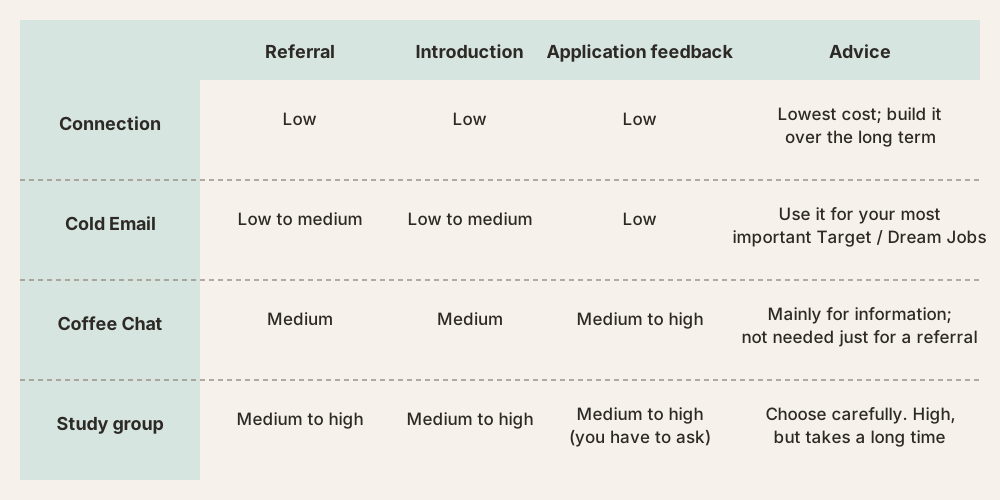
Connection
My own practice is to make a small number of connections regularly. I start with people working in my target field or target country, look at the suggestions on LinkedIn or Facebook, and connect with the most relevant people first. When we have mutual connections, the acceptance rate is usually above 50%.
These don’t necessarily convert into a high positive response rate, but it’s a small long-term habit that builds up the people you know, which is what LinkedIn was originally for.
- For referrals: some help, because it’s easy to do, but people rarely offer to refer you on their own.
- For introductions and application feedback: limited help, unless you interact further.
Don’t worry too much about whether you’re making the “right” connections. What makes people help you isn’t the connection itself, it’s whether they’re willing to help or value the relationship. Not every connection will get the same attention, but the methods below can move relationships further.
Cold Email
If a connection request is like handing out flyers on the street, a cold email is like putting a letter straight into someone’s mailbox. It’s more targeted, but it takes more time, and you shouldn’t use a canned message.
I usually write cold emails for companies where I’m targeting a specific opening, for example writing directly to the recruiter for that role. With complete strangers, the success rate is roughly 10%, but nearly all of that 10% turns into positive responses. Sending lots of cold messages on LinkedIn may require upgrading to Premium.
- For referrals: more helpful, because the message (if well written) explains why you’re reaching out and makes people more willing to recommend you.
- For introductions and application feedback: limited help.
Weigh the time cost. I usually only send cold emails for Dream Job and Target Job roles.
Coffee Chat
It’s hard to set up a coffee chat straight from a connection request. They come more often from cold emails, long-term relationships, or introductions. With complete strangers, the coffee chat success rate is roughly 5%, and that 5% doesn’t always turn into positive responses. But you usually get the most direct information, and your chances of being introduced or referred are higher than with the previous two.
My advice: if all you want is a referral, a cold email is enough. Given the time cost, there’s no need to schedule an extra 15 or 30 minute chat.
Coffee chats work well when you have a specific question that’s hard to resolve quickly in writing, such as visas or someone’s personal journey. That’s when talking face to face makes sense.
Study group
Study groups (reading groups, conferences, job seekers’ groups, agile learning circles and so on) are a way to connect with people in depth. Through learning and discussing together over time, you can build deeper relationships and show your professional ability.
- For referrals: indirect help, because group members know your ability and attitude better and are more likely to recommend you.
- For introductions: the biggest benefit. Members may recommend you to friends in the industry or to other opportunities.
- For application feedback: clearly helpful. Members can give each other feedback on resumes and portfolios and improve the quality of their application materials.
However, study groups take a long-term time commitment, and the boost to your response rate may not show in the short term. If you have enough time, it’s worth the investment. But on a tight job search timeline, you may need to weigh the time cost.
I personally love joining communities and events, but I don’t count that as time spent on my job search. I file it under fun or social time.
Time invested vs response rate
It’s worth noting that while depth of connection and time spent usually rise together, the contribution to your response rate doesn’t necessarily rise with them. In other words, activities that take more time don’t necessarily bring a higher response rate.
Why? Because job hunting is about acting efficiently and strategically. Some high-commitment activities (like study groups) may help your long-term career, but the payoff for a short-term job search may not show up right away.
So choose the most effective actions based on your own time and needs.
Balancing purpose and relationship building
In a job search we’re inevitably goal-driven. At the same time, we need to balance that purpose with building genuine relationships. Approaching people purely for your job search can make them feel used, and that makes them less willing to help.
So when connecting with people, I suggest you:
- Show genuine interest: care about their experience and ideas, not just what they can do for you.
- Stay in touch: even after your job search ends, keep in contact and maintain the relationship over time.
Connection goes both ways. In the long run, think about what you can “give” when you connect with people. Of course, early in our careers we mostly receive.
The simplest way to give is to say thank you. Whether it’s a letter, a message or a review, giving back for what you received, publicly or privately, supports these “givers” so they can keep going, and it makes the relationship last longer.
A bonus question
Here’s a quiz for you: “Should I use a headhunter?” and “Should I include proof of my English test scores?” How would you figure out which companies these are worth doing for, and which they aren’t?
Summary
Job hunting takes strategy and efficiency. By understanding how each way of connecting with people affects your positive response rate, you can split your time and energy more effectively.
Connection, cold email, coffee chat and study groups each have their pros and cons. The key is choosing the strategy that best fits your needs and your time.
At the same time, don’t forget to balance your job search goals with building relationships. Engaging with people genuinely is what carries you further in your career.
I hope these suggestions make your job search go more smoothly and help you find the job you want!