
Is a Cover Letter Worth It? How Much Time to Spend on Portfolios and Cover Letters When Applying Abroad
Why this topic matters
Deciding how to split your time for the best results is a challenge for many job seekers. Is a cover letter worth it? Is a portfolio worth it? In this article I use the response rate to look at how well different strategies work, so you can prepare your portfolio and cover letter more efficiently and improve how you apply.
Once you’ve covered the main points of your resume, you reach the deepest question about response rate: what is the most effective way to apply? This is where people usually get stuck. They spend a lot of time preparing a portfolio, writing cover letters, looking for referrals, connecting with senior people for coffee chats, or setting up study groups.
This topic comes in two parts. This first part focuses on the core idea, cover letters and portfolios. The second part focuses on connecting with people.
A familiar scene
When it’s time to apply for a job, I often hear things like:
- “My portfolio isn’t ready yet, so I can’t apply for this one.”
- “I’m weaker in this skill right now, so I need to add it to my portfolio first.”
- “I’ve forgotten some of what’s in my portfolio, I need to brush it up before the interview.”
- “My cover letter isn’t written yet, and I’m not sure what’s the right way to write it.”
These are real questions that come up during a job search.
People preparing for front-end or design roles often tell me, “My portfolio isn’t ready.” We all want our work to be closer to perfect before anyone sees it. That’s completely reasonable. But when is it “ready” enough to send?
By “effective” I mean spending the least time (input) for the biggest result (output). All of these steps belong to the early stage of applying, so the number they mainly affect is still the positive response rate.
Preparing your portfolio
Your response rate decides whether you’re ready.
A quick refresher: what is the positive response rate?
It’s the share of applications that get a positive reply from the company, such as an invitation to interview, a phone screen, or a request for more information. It tells you directly whether your application strategy is working. Assuming your resume stays roughly the same, it shows whether your portfolio and cover letter caught the recruiter’s attention.
Why use response rate as the measure?
During a job search, we often focus on perfecting our portfolio and cover letter and forget to look at what they actually achieve.
In fact, however much time you spend preparing, the goal is to get an interview. Before the interview stage, the response rate is the direct measure of how well your applications are doing.
By analyzing your response rate, you can adjust your strategy, use your time better and improve your chances.
A job search isn’t like showing off your work. You don’t need one exceptionally high score. You need to pass every stage (response rate, interview rate, offer rate), and give each stage the information it needs to let you through.
At least in the early stage, your portfolio and cover letter shouldn’t be what’s stopping you from applying.
Look at your portfolio through your response rate
I’m not telling you to skip the portfolio entirely. Some companies and roles do need one, especially researcher, designer and front-end engineer roles.
But there are two layers of response rate to look at:
- Response rate with vs. without a portfolio: For some roles, you may already have strong enough experience that a portfolio isn’t essential. In that case your response rate will be relatively high without one.
- Response rate with different versions of your portfolio: When you send different versions, compare the response rates between them. Is there a difference? Which portfolio works especially well for which kind of role?
For example, when Alex applied for engineering roles, he used two approaches: resume only, and resume plus a simple portfolio. Adding the portfolio raised his response rate by 30% for front-end engineer roles, but made no significant difference for full-stack roles.
This shows that for some roles, a portfolio really can make you much more visible.
These two layers together tell you whether your portfolio is actually “ready.”
Use click-through rate as a backup measure
But for jobs abroad, it’s more common to get no reply at all. What then?
Besides looking at your rejection rate within a week, the other key is the click-through rate.
Put your portfolio behind a trackable link or short URL, and use the click-through rate as another signal:
- If there are no clicks at all, the problem is most likely your resume, not your portfolio.
- If there are clicks but no positive replies, your resume or portfolio probably needs more work.
- If clicks line up with positive replies (for example, you apply to companies in California and see clicks from California), you’re probably on the right track.
How to adjust based on click-through rate
- If your click-through rate is high but your response rate is low, check whether your portfolio content matches what the role needs, and whether your resume is clear.
- If your click-through rate is low, you may need to make your resume more compelling, or change the range of roles you apply for.
How to measure clicks
You can set up click tracking with these services:
- Bitly: Custom short links with detailed tracking. The free basic plan already covers what you need for analysis.
- TinyURL: A long-standing link shortener. Simple to use, and lets you customize the URL.
- PicSee: Built mainly for marketers posting on social media. It creates short links without sign-up, lets you customize the preview image and title, and generates UTM parameters. The dashboard is fairly complete, though you won’t need every feature for a job search.
- Reurl: A privacy-focused short-link service. It can hide click counts and lets you fill in UTM parameters directly.
A warning: Be careful using short links on a resume you send by email. Because the destination of a short link isn’t clear, I’ve seen emails land in the spam folder. When you send your resume (or portfolio) by email, follow up with a separate email to confirm they received it.
Use Google Analytics for simple view tracking
The main thing I strongly recommend is installing Google Analytics (GA) on your portfolio to track how people interact with it.
Narrow it down to users in the country where you’re job hunting (for example, the US). If you can match the timing more precisely, you may be able to tell which visit is likely a recruiter, and see how they engaged with your portfolio.
For example:
- They clicked the link, but the page took too long to load and they dropped off
- They clicked the link, but didn’t scroll, and left after seeing the cover page
- They clicked the link but left very quickly (within five seconds)
- They clicked the link and the page loaded, but some images took too long to load and hurt the experience
All of these are data you can analyze.
A privacy reminder: When you use GA or link shorteners to track recruiters’ interactions, follow the relevant privacy laws and respect their privacy.
I don’t recommend tracking too much or collecting too much personal data. Use these tools in moderation, with the goal of improving your own materials, and don’t share this data publicly. This matters especially in Europe, where privacy is taken very seriously.
”Get it done first, make it good later”: polish it once you land the interview
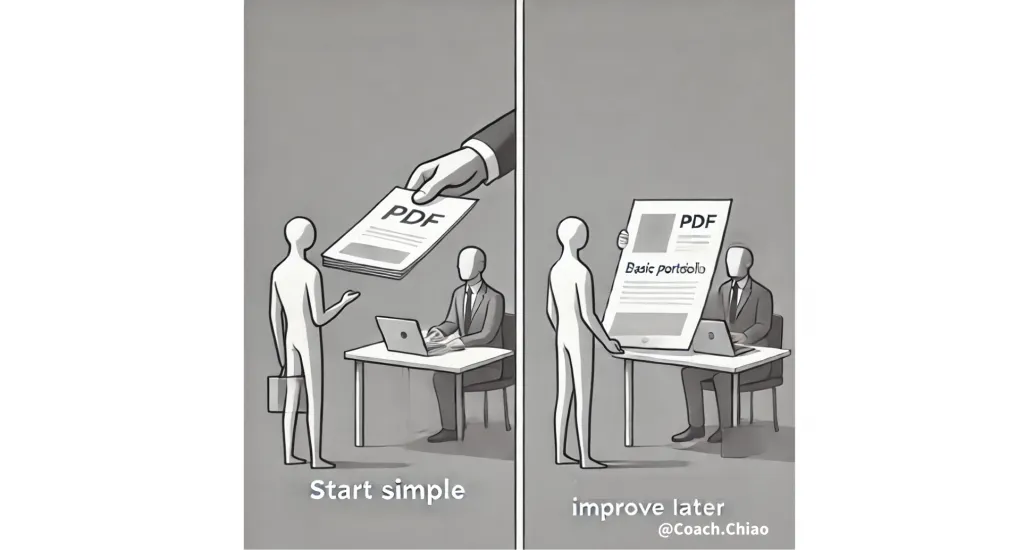
My other piece of advice on portfolios: get it done first, then make it good (before the interview).
After all, the first reader is the recruiter. At least at the positive-response stage, you shouldn’t go deep on your portfolio. A polished portfolio is usually needed at the interview stage, when you should rework it and send the files to the interviewer beforehand.
At this point I’d suggest building your portfolio lightly, using ready-made templates on Behance, GitHub Pages and the like.
So how simple can “done” be?
I’ve actually seen people send a PDF exported from Google Docs and still get high click-through and response rates. You could try sending a PDF early on. Maybe you’re the lucky one.
But recruiters have seen it all, and something too bare-bones may not get through. Either way, the response rate tells you.
Is a Cover Letter Worth It?
People ask whether cover letters matter. I think you know the answer: check your response rate.
With portfolios, we use the response rate to judge whether you’ve prepared enough. Cover letters are the same: the response rate is the main measure.
But for certain roles and cultures, pay closer attention to how not including a cover letter affects your response rate.
For companies that receive fewer applications, and for Japan, I recommend including a cover letter whenever you can.
In Japanese hiring culture, a cover letter is seen as a sign of how careful and committed the candidate is, so it’s often a key factor in whether the employer replies.
Companies that receive fewer applications have more time to read each document closely, which makes the cover letter matter even more.
If adding a cover letter doesn’t raise your response rate, then weigh the time it costs you.
I don’t put a time budget on portfolios, because what each person needs varies a lot, and it’s a one-time effort.
But if every cover letter takes more than fifteen minutes, every job needs one, and your response rate isn’t any higher, you can imagine how painful that gets.
My suggestion:
- Dream Job: spend more time on the letter
- Target: no more than ten minutes
- Acceptable: no cover letter, or under three minutes
This is where an LLM like ChatGPT helps.
With an LLM like ChatGPT, you can generate a cover letter tailored to a specific role in a short time.
Remember to give it the key information, such as the job title, what stands out about the company and your relevant experience. Then proofread carefully after it’s generated, to make sure the content is true and sounds like you.
Summary
In a job search, time and energy are precious.
By using your response rate and click-through rate as measures, you can judge your application strategy more effectively and find the way of preparing that suits you best.
Remember: don’t let perfectionism hold you back. Act first, then optimize.
Use the tools well and respect cultural differences, and you’ll have a better chance of landing the role you want.
If you’d like to keep following along, the next article in this series covers connecting with people: referrals, cold emails and coffee chats.